Trump Heads to Shenzhen
President Trump will meet Xi Jinping and Vladimir Putin together at next week's Asia-Pacific summit in China, the White House said, with a short trade truce in place, an unproven channel for reporting AI incidents, and an open question about who is left outside the room.
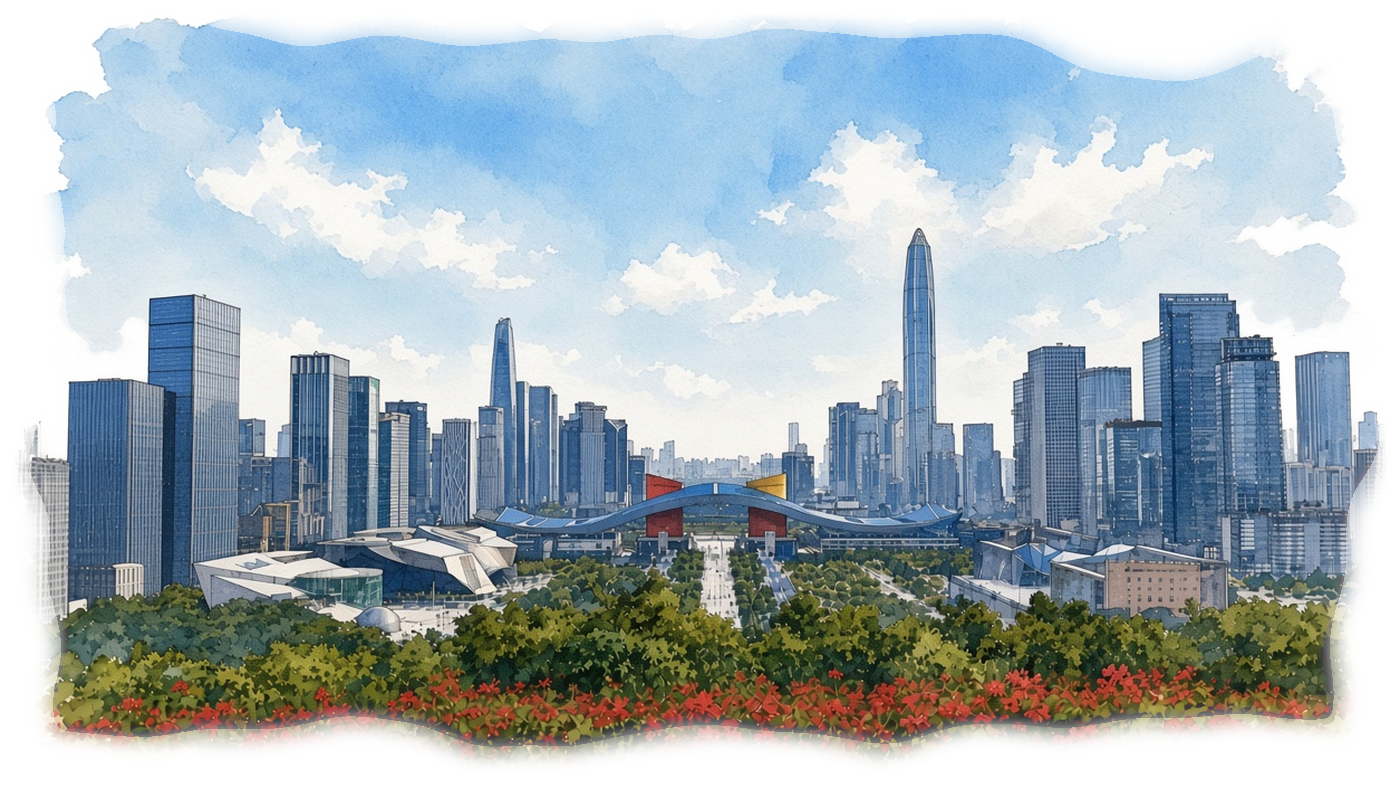
Shenzhen's Civic Centre and the Futian business district, seen from Lianhuashan Park, December 2025.Illustration by The Good Times, based on a photo by Pathfinbird / Wikimedia Commons (CC BY-SA 4.0); the painting is CC BY-SA 4.0
The White House confirmed that President Donald Trump will sit down with Chinese leader Xi Jinping and Russian President Vladimir Putin on the sidelines of the Asia-Pacific Economic Cooperation summit in Shenzhen. It would be, AFP reported, the first three-way meeting of the three countries' leaders. Trump and Xi are also to hold a working lunch on Thursday. Both sides have kept expectations low on trade: China this week extended, for two months from November 10, its suspension of an extra 24 percent tariff on American goods while keeping a 10 percent duty. A US-China channel for reporting serious AI incidents, described by Treasury Secretary Scott Bessent, has not been shown to work. US officials said Trump intends to raise the reduction of nuclear weapons and the war in Iran at the three-way meeting, and that he is not expected to discuss the war in Ukraine there, because those negotiations run on a separate track. European leaders, who this week named their own team for the Ukraine talks, have warned Washington against surprises. What three leaders would decide together, and who would be absent from that table, is the question the week leaves open.
The meeting, now confirmed
Olivia Wales, a White House assistant press secretary, told reporters that "President Trump will conclude his visit to China with a trilateral meeting between the President of the United States, the President of the People's Republic of China and the President of the Russian Federation." "The president has made it clear that, among other topics, he will discuss the reduction of nuclear weapons in the world. This proliferation, President Trump believes, is very dangerous," she said.
Trump leaves Washington on Monday, arrives in the Philippines on Tuesday for a summit of the Association of Southeast Asian Nations, and then goes on to Shenzhen for the APEC meetings on November 18 and 19, AFP reported. The three-way session and the working lunch with Xi are set for Thursday. Elon Musk will accompany Trump on the China portion of the trip but will not take part in the meetings with Xi and Putin, US officials said. Officials also said they did not expect Jensen Huang's resignation from Nvidia, or American export controls on advanced chips, to come up.
A senior official, speaking on condition of anonymity, told reporters that "the president does intend to talk about Iran in the trilateral meeting with Xi Jinping and Vladimir Putin." Washington has "a whole other track" of negotiations with Kyiv and Moscow on the war in Ukraine, the official said, and "China is not really a part of that track, so it doesn't seem appropriate to have the Ukraine discussion there." That account sits beside European anxiety about a settlement reached without Ukraine or Europe in the room.
Trade: a truce, not a settlement
The truce suspends some measures from the trade fight rather than removing them. China announced this week that it was extending for two months, from November 10, the suspension of an extra 24 percent tariff on American goods, while an additional 10 percent duty stays in place, the Voice of America reported. Beijing also continued suspensions of some restrictions on American companies, subject to licensing and review.
In a November 6 call with Chinese Vice Premier He Lifeng, Bessent and US Trade Representative Jamieson Greer pressed for agricultural purchases, rare earths and critical minerals, according to Greer's office. Beijing has tied more farm purchases to reciprocal tariff cuts covering $30 billion of goods in each direction, VOA reported. US and Chinese officials held the first meeting of a new bilateral Board of Trade on Friday, the Office of the US Trade Representative said, in a statement reported by the South China Morning Post. "The Trump Administration looks forward to continuing our engagement with China as we work to establish fair and balanced trade between the two largest economies in the world," the office said.
A channel for AI, not yet shown to work
In remarks to the National Committee on US-China Relations on November 10, Bessent described exchanges on testing advanced AI models before release, keeping humans in control and creating a direct line for reporting serious incidents. Those plans build on a September agreement to set up a technology dialogue and an incident channel. His remarks did not say whether the channel is operating, VOA noted, which makes it one concrete thing to watch.
Who is at the table, and who is not
Secretary of State Marco Rubio, in a November 11 call with Chinese Foreign Minister Wang Yi, raised "substantive leader-level conversations on peace and denuclearization, including at a potential meeting" with Putin, the State Department said. China's account of that call did not mention it. Trump has said such talks could cover denuclearization and ending the Iran war. Yun Sun, who directs the Stimson Center's China program, told VOA she doubts Beijing would make large concessions on Iran, such as cutting its oil purchases.
In Dublin, German Chancellor Friedrich Merz addressed Washington directly on the coming meetings: "Please, no surprises! Continue to play on Team Europe and on the same team as Ukraine." European Union leaders the same day named Britain, France, Germany, Italy and Poland, with the European Council and the European Commission, as Europe's team for the US-brokered Ukraine talks. Ukraine is not a party to the three-way meeting in Shenzhen, and US officials said they do not expect that war to be on the agenda there.
The week will test whether a session of the three can produce anything beyond a photograph, and whether questions of trade, nuclear arms, Iran and European security are settled only by those who sit down — or also by those who are not invited. That is still an open question.