Europe Names Its Ukraine Team
EU leaders agreed that Britain, France, Germany, Italy and Poland, together with the EU's Council and Commission, will speak for Europe in the US-brokered talks to end the war in Ukraine.
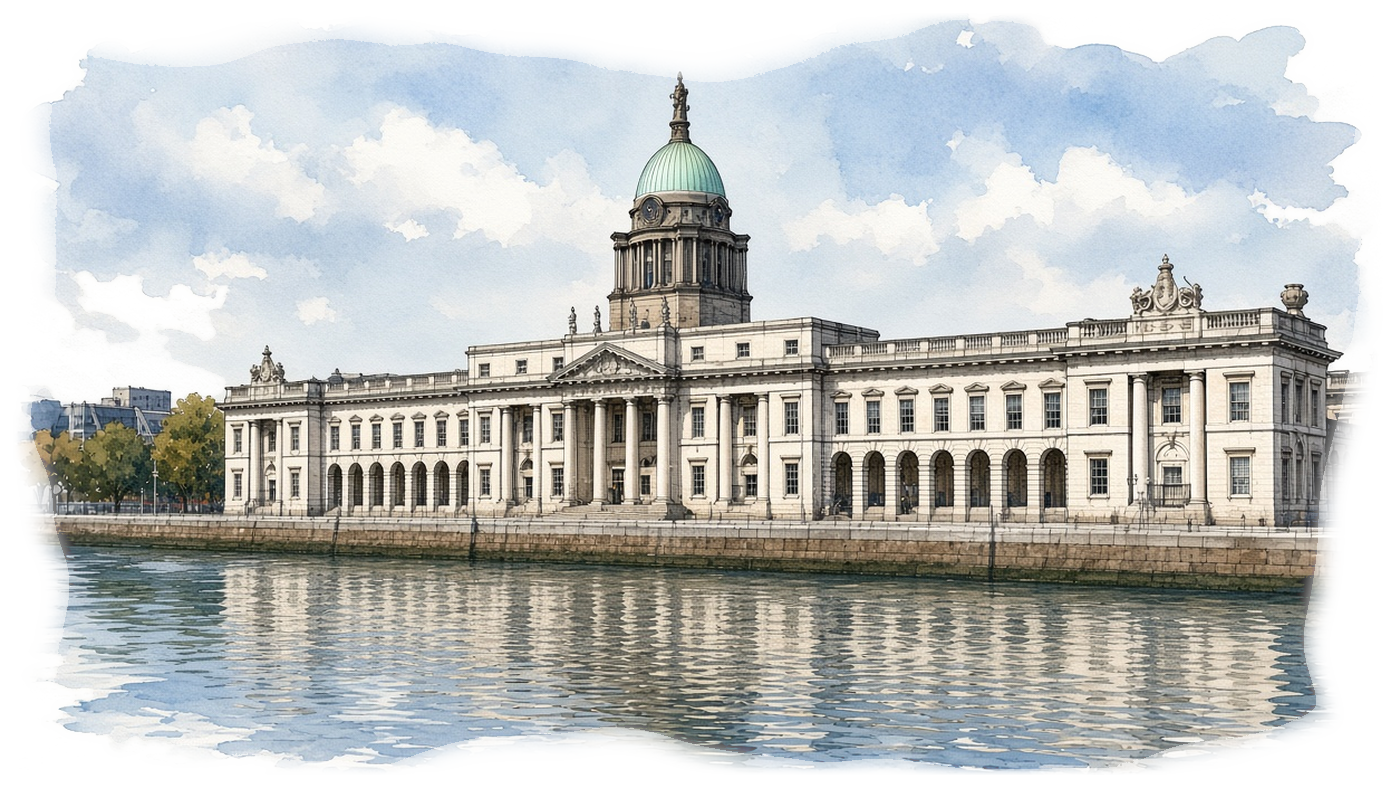
The Custom House on the River Liffey in Dublin, August 2025.Illustration by The Good Times, based on a photo by Mathieu Chollet / Wikimedia Commons (CC BY-SA 4.0); the painting is CC BY-SA 4.0
The leaders of the European Union's 27 countries agreed on who will represent Europe at future peace talks on Ukraine: national security officials from Britain, France, Germany, Italy and Poland, the group known as the E5, plus the European Council and the European Commission. "It is essential to have a team and to speak with one voice," European Council President António Costa said after the informal summit in Dublin, noting that President Donald Trump has two envoys, Steve Witkoff and Jared Kushner, running the talks. Leaders declined to name a single European envoy, as Italian Prime Minister Giorgia Meloni had urged. German Chancellor Friedrich Merz had preferred a narrower group of Berlin, Paris and London, while the EU's foreign policy chief, Kaja Kallas, argued she should lead, Politico Europe and Euronews reported. The deal comes ahead of a meeting of Trump, Xi Jinping and Vladimir Putin in China next week, which the White House has confirmed. "Please, no surprises!" Merz said, addressing Washington. Costa said the leaders will take up Ukraine's financing needs for next year at a summit on November 26 and 27, and Commission President Ursula von der Leyen said the Commission will propose a 22nd package of sanctions on Russia before then.
Who is on the team
Costa said the leaders agreed that "our European team for the negotiations on peace in Ukraine is the European Union institutions and the E5 of the Coalition of the Willing," the group of countries that has pledged security guarantees for Ukraine after a ceasefire. Britain is not an EU member but sits in the E5. Von der Leyen said she welcomed a team of the E5 and the two EU institutions, the Council and the Commission.
"We decide on who represents us, and that's what we've done today," she said. The talks so far have been among national security advisers and senior officials rather than heads of government. Euronews reported that the E3 countries — France, Germany and Britain — plus EU institutions had already been represented at recent rounds in Miami, Oslo, Brussels and Abu Dhabi, that Italy took part in the Abu Dhabi meeting, and that Poland is expected to join the next round.
How they got there
Leaders came to Dublin to discuss artificial intelligence, but the talks on Ukraine took most of the day, Politico Europe reported. Meloni had criticized the "disarray" of European voices and called for a single envoy, Euronews reported; instead the leaders expanded the existing group, adding Italy and Poland. Warsaw had warned against Western European countries making decisions on behalf of the East. Merz said the narrower format "has proven very effective" and that "we always include Italy and Poland." "In that regard, I don't see any need to have an institutional debate at the moment," he said.
Kallas had argued that representing the bloc on foreign policy was part of her mandate. "I know that the Russians don't want me, but do we have a say on who is representing Russia? No, we don't," she said. Costa pointed to the EU treaties, saying the Council president represents the Union at the level of heads of state and government on common foreign and security policy.
Europe was kept out of the core negotiations in Abu Dhabi earlier this week, where Russian and Ukrainian delegations met with US mediators. Witkoff and Kushner went to Moscow on Thursday. After that meeting, Euronews reported, the American envoys said Moscow had indicated it was willing to hold face-to-face talks with Europeans; the Kremlin played the suggestion down. Kremlin spokesman Dmitry Peskov said Europeans must first show "genuine intention and readiness to contribute to the peace process." Kallas called that "a trap." Other officials told Politico Europe that Russia's terms would mean concessions such as NATO pulling back from states bordering Russia, lifting sanctions and barring foreign troops from Ukraine.
What comes next
The White House on Friday confirmed that Trump, Xi and Putin will meet on the sidelines of the Asia-Pacific Economic Cooperation summit in Shenzhen on November 18 and 19. European officials have warned against any deal struck over Europe's head. "Please, no surprises!" Merz said. "Continue to play on Team Europe and on the same team as Ukraine."
Costa said "our most urgent priority is to provide the financial and military assistance Ukraine needs," and that leaders will discuss Ukraine's financing needs for next year and beyond at the European Council on November 26 and 27, building on proposals from the Commission. Von der Leyen said the Commission will present a plan to cover Ukraine's 2027 funding gap before that meeting, and that it will soon propose the 22nd package of sanctions, Interfax Ukraine reported, quoting the Dublin press conference.