Mercedes Freezes Spending at Home
Mercedes-Benz halted all further investment at its German plants and is weighing closing an assembly plant and a powertrain plant.
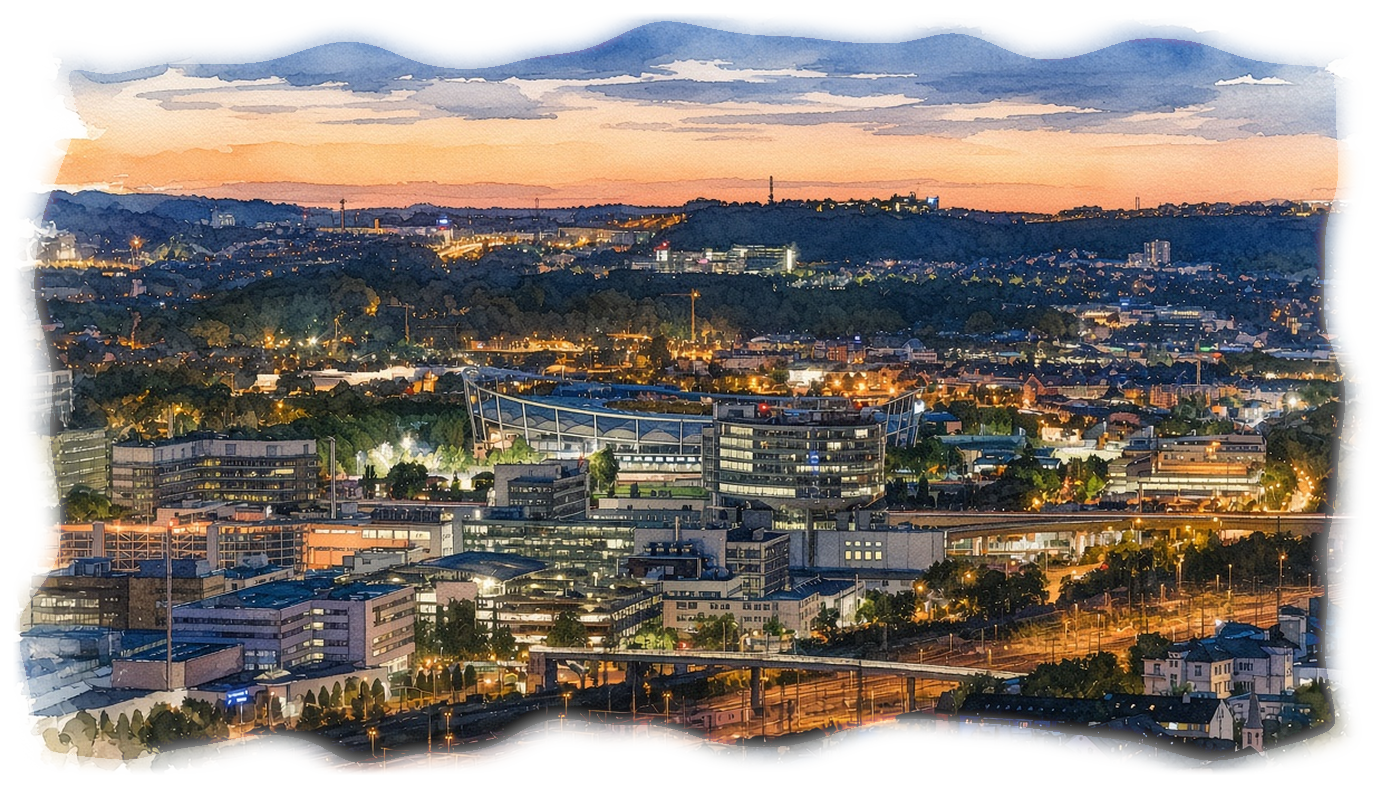
The Mercedes-Benz Untertürkheim plant and Stuttgart's Neckar valley at dusk, September 2015.Illustration by The Good Times, based on a photo by Julian Herzog / Wikimedia Commons (CC BY 4.0)
Mercedes-Benz has stopped all further investment at its sites in Germany and is examining which German plants it can still afford to keep. "The executive board has jointly decided to halt all further investments in German sites," board member Michael Schiebe, the chief production officer, wrote in an internal memo seen by AFP. He had already warned that one vehicle assembly plant and one powertrain plant could close unless costs fall; the company has not named which. Talks with the works council and the IG Metall union are deadlocked. The company says an hour of labor in Germany can cost up to five times as much as in Eastern Europe, and it wants longer hours without more pay and cuts to bonuses. Its sales in China, historically about a third of its car sales, fell about 19% in 2025, demand for electric cars has been slower than carmakers expected, cheaper Chinese electric cars are competing in Europe, and Mercedes says US tariffs cost it about €1 billion in profit last year. Volkswagen and Audi have announced their own cuts. No plant has been named, and no agreement with the union is in sight.
The board of Mercedes-Benz decided to halt all further investment at its German sites for the time being, according to an internal memo from production chief Michael Schiebe reported by AFP and Deutsche Welle. "The executive board has jointly decided to halt all further investments in German sites," he wrote. Deutsche Welle reported that he said current cost structures make it impossible to invest in Germany.
Mercedes told Automotive Manufacturing Solutions that the freeze does not affect investments already underway, such as the billion-euro paint shop under construction at Sindelfingen.
What Mercedes is weighing
Board member Britta Seeger, who oversees personnel, said in an interview on the company intranet that Mercedes is "forced to examine, in concrete and detailed terms, which sites in Germany we can still afford to maintain." She added: "We all want to avoid plant closures at all costs. Unfortunately, however, we must now pursue this option in more concrete terms."
Schiebe said weeks ago that two German plants, one vehicle assembly plant and one powertrain plant that builds components, would have to close if costs were not cut. Mercedes assembles cars at Sindelfingen, Rastatt and Bremen among other places, and makes powertrains at Stuttgart-Untertürkheim, Berlin, Hamburg, Kamenz and elsewhere, Euronews reported. No plant has been named.
What the company wants from workers
Mercedes says an hour of labor at its German plants can cost up to five times as much as at its sites in Eastern Europe. Management is asking for longer working hours without higher pay, and profit-sharing, holiday and Christmas bonuses could be cut, Euronews reported. Talks with the works council and IG Metall are deadlocked, Seeger said, and employees have protested the demands.
The pressures behind it
Demand in China, which has historically made up about a third of Mercedes' passenger-car sales, has weakened, and its Chinese sales fell about 19% in 2025, Deutsche Welle reported. Electric-car demand in Europe and North America has grown more slowly than manufacturers planned, while cheaper electric cars from China compete in Europe. Mercedes has said US tariffs cost it about €1 billion ($1.1 billion) in profit last year.
The company is not alone. Volkswagen and its Audi brand have announced large savings programs and job cuts, and BMW and Porsche face similar strains. Automotive analyst Ferdinand Dudenhöffer told Bild that without a basic change in cost structures, Germany's car industry risks losing more of its competitiveness.
No plant has been named, and Seeger said a swift agreement with the union is not in sight.