France Buys a One-of-a-Kind Dinosaur
The state halts the auction of the only known Dubreuillosaurus skeleton, a 167-million-year-old meat-eater from Normandy, and sends it to the Paris natural history museum.
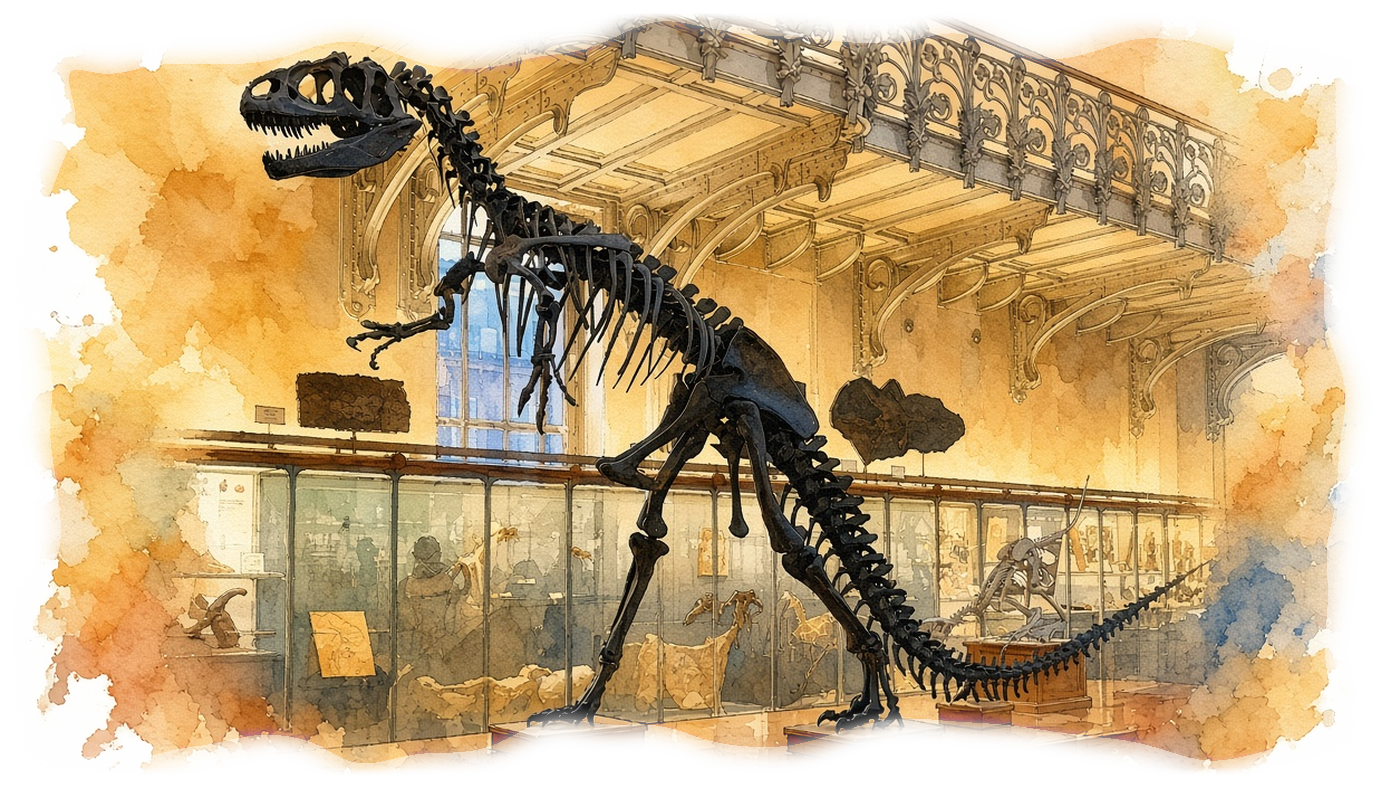
An Allosaurus cast in the paleontology gallery of the National Museum of Natural History in Paris, where the Dubreuillosaurus skeleton is headed, October 2025.Illustration by The Good Times, based on a photo by Soupaloignon95 / Wikimedia Commons (CC0)
France has bought the only known skeleton of the dinosaur Dubreuillosaurus valesdunensis for the National Museum of Natural History in Paris, stopping an auction that had worried paleontologists. The 167-million-year-old fossil, a two-legged meat-eater from the Middle Jurassic related to the megalosaurs, was found in Normandy in 1994 by André Dubreuil, then a village mayor. Museum teams excavated more than 2,000 bones and described it as a new species. Because it is the only specimen, scientists use it as the reference for identifying any similar fossil. Dubreuil's heirs had put the skeleton up for sale at the Hôtel Drouot in Paris on November 18, with an estimate of 250,000 to 350,000 euros. Two ministries funded the purchase by private agreement, which they said keeps the fossil in France and open to researchers and the public. A petition had drawn nearly 5,000 signatures. Museum president Gilles Bloch welcomed a fossil "that our researchers excavated, prepared and studied."
The French government has bought the only known skeleton of the dinosaur Dubreuillosaurus valesdunensis and placed it in the collections of the National Museum of Natural History in Paris, withdrawing it from an auction scheduled for later this month.
Catherine Pégard, the culture minister, and Philippe Baptiste, the minister for higher education and research, announced the acquisition. Their ministries released an exceptional grant to buy the fossil by private agreement, which they said guarantees that it stays in France and remains accessible to scientists and the general public.
"We are delighted that this exceptional fossil, which our researchers excavated, prepared and studied, is entering the collections of the National Museum of Natural History," said Gilles Bloch, the museum's president.
A reference specimen
André Dubreuil, then mayor of the Normandy village of Conteville, discovered the fossil in 1994. Teams working under the museum, the national research agency CNRS and Sorbonne University carried out several excavation campaigns and removed more than 2,000 bones, including the skull, claws and vertebrae. After years of study, paleontologists concluded that it was a new species of theropod, the group of two-legged meat-eating dinosaurs, related to the megalosaurs. It lived in the Middle Jurassic, about 167 million years ago, and was named in honor of its discoverer.
Its skull is among the most complete and best preserved of any theropod found in Europe, and the find has improved knowledge of megalosaur anatomy, which had been largely unknown. The specimen is a holotype, the single example on which a species is defined. "We would no longer have had a point of comparison," said Marie-Béatrice Forel, director of collections at the museum, explaining why scientists had feared a private sale. Other dinosaur specimens found in Normandy were destroyed in the bombing of 1944.
The sale that did not happen
Dubreuil entrusted the skeleton to the Paléospace, a paleontology museum in Villers-sur-Mer, where it was shown to the public laid out flat rather than mounted. His heirs later decided to sell it through the auction house Millon at the Hôtel Drouot in Paris on November 18, with an estimate of 250,000 to 350,000 euros. A petition started by a student, Mattéo Gagnaire, gathered nearly 5,000 signatures, and an online fund raised 17,000 euros. "Tremendous news, enormous relief," said Bastien Mennecart, president of the French Paleontological Association.
The skeleton is expected to join the Gallery of Paleontology and Comparative Anatomy at the Jardin des Plantes, which is scheduled to reopen in the summer of 2027; a date for its public presentation has not been set. Researchers plan new scans to produce a fresh biomechanical reconstruction.
A wider market
The purchase comes as dinosaur fossils increasingly sell to private buyers. A Nanotyrannus specimen sold at auction in New York in early November for 42 million euros. By the count of the American paleontologist Thomas Carr, 71 Tyrannosaurus rex skeletons are in private hands and 61 in institutions open to the public. Supporters of the Dubreuillosaurus campaign have contacted French lawmakers about tighter protection for fossils, citing Mongolia, which bans the export of dinosaur remains found on its soil.