Eisenkot Gets First Chance
Isaac Herzog chooses Gadi Eisenkot to try to form Israel’s next government, but recommendations for the mandate do not yet add up to a governing coalition.
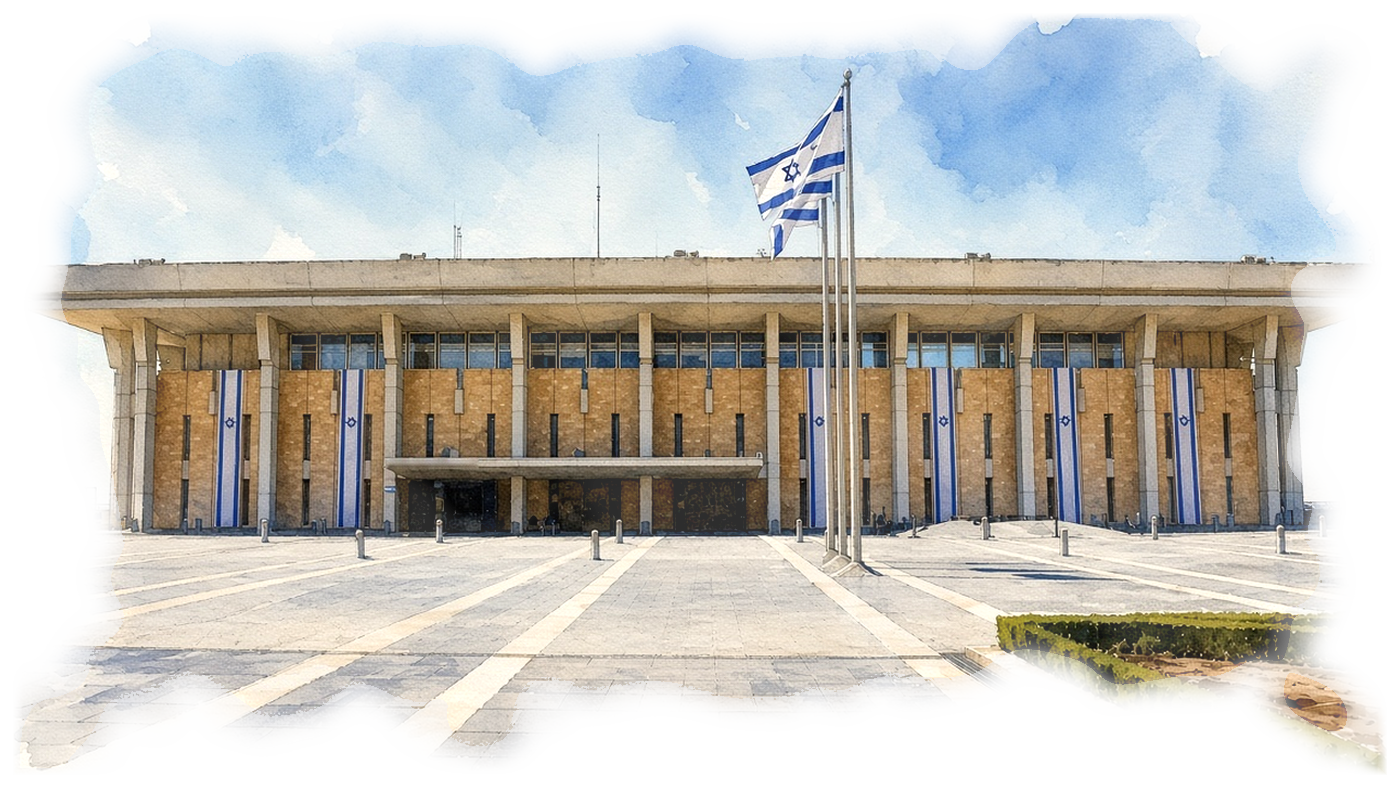
The Knesset in Jerusalem, July 2022.Illustration by The Good Times, based on a photo by Clema12 / Wikimedia Commons (CC BY-SA 4.0)
President Isaac Herzog has chosen Gadi Eisenkot to try to form Israel’s next government, giving the former military chief the first opportunity ahead of Prime Minister Benjamin Netanyahu. Herzog announced the decision, with the formal mandate still to be handed over. Eisenkot, leader of Yashar, will then have 28 days to form a government, with a possible extension of up to 14 days. During the president’s consultations, lawmakers representing 67 of the Knesset’s 120 seats recommended Eisenkot, compared with 46 for Netanyahu. Those recommendations are not a coalition agreement. Neither leader’s bloc won a governing majority in the October 27 election. Eisenkot’s four-party alliance took 48 seats, leaving him dependent on support beyond it. He called for a national emergency government after Herzog’s announcement; Netanyahu separately called for national unity. No new government has been sworn in, and the president’s choice does not itself remove Netanyahu from office.
President Isaac Herzog has chosen Gadi Eisenkot to attempt to form Israel’s next government, passing over Prime Minister Benjamin Netanyahu for the first mandate after an election that left both leaders’ blocs short of a majority.
Herzog announced his decision on November 7 after consultations with parliamentary parties and further meetings with Eisenkot and Netanyahu. The formal handover of the mandate is scheduled for November 8 at the President’s Residence in Jerusalem.
Once he receives it, Eisenkot will have 28 days to assemble a government. Herzog can grant an extension of up to 14 days. The former military chief leads the Yashar party and would need support beyond his existing alliance to establish a government able to win parliament’s confidence.
During the presidential consultations, factions representing 67 members of the 120-seat Knesset recommended Eisenkot for the task, while 46 recommended Netanyahu, according to the president’s office. United Torah Judaism, which has seven seats, made no recommendation.
The majority recommending Eisenkot is not the same as a majority committed to joining or sustaining his government. His four-party alliance won 48 seats in the October 27 election, while Netanyahu’s bloc won 53. Neither reached 61, and Eisenkot has not agreed on a governing coalition with all the parties that recommended him.
After Herzog’s announcement, Eisenkot posted a photograph of himself shaking hands with the president and called for a national emergency government. “I will do everything to ensure we prove ourselves worthy,” he wrote, according to ABC News.
Netanyahu had separately called for a national unity government. The Times of Israel reported that Eisenkot’s party said Likud could join a government under Eisenkot subject to its conditions, but that the invitation did not extend to Netanyahu personally. Eisenkot has repeatedly said he will not enter a coalition with the incumbent prime minister.
The negotiations will determine whether those competing positions can produce a government. Herzog’s announcement selects the politician who will receive the first opportunity to try; it is not the swearing-in of a replacement prime minister.
If Eisenkot cannot form a government within the allotted period, the president can give another candidate the opportunity. If successive attempts fail, Israel could face another election. Netanyahu remains prime minister while the formation process continues.
Security and the conduct of Israel’s wars were central to the election campaign, ABC News reported. The decision now begins the coalition-building stage, with Eisenkot needing to turn recommendations for his candidacy into parliamentary support for an actual government.