Japan Sends a Probe to Bring Back a Piece of Mars's Moon
Japan's H3 rocket lifted the Martian Moons eXploration probe, MMX, off its pad and sent it on its way to Mars, where it is to land twice on the moon Phobos and bring at least 10 grams of it back to Earth. NASA built one of its instruments and its sampler, and at least 15% of the sample is reserved for NASA's labs in Houston.
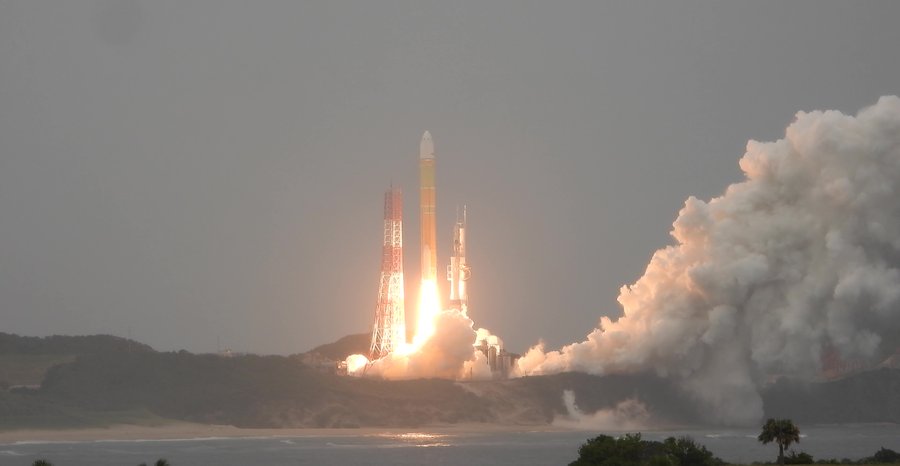
Japan launched a spacecraft to Mars that is designed to land on the planet's moon Phobos, scoop up some of its surface and fly it back to Earth. No spacecraft has ever returned material from the Mars system.
The Martian Moons eXploration probe, called MMX, lifted off on Japan's H3 rocket from the Tanegashima Space Center at 4:41 a.m. local time, 3:41 p.m. Eastern. About 71 minutes later the spacecraft separated from the rocket's upper stage on schedule, to cheers in mission control, and is now on course for Mars.
It is due to reach Mars in August 2027 and spend about three years there. It will drop a small French-German rover, Idefix, onto Phobos, then land twice to collect at least 10 grams of material, and fly past the smaller moon, Deimos. The sample capsule is to land in Australia in 2031.
NASA built a gamma-ray and neutron instrument and a sampler for the mission and has invested about $87 million. At least 15% of the returned sample is reserved for NASA and will be kept at the Johnson Space Center in Houston.
Tanegashima, Japan — Japan launched a spacecraft that is built to land on Phobos, the larger of Mars's two moons, collect a sample of its surface and bring it back to Earth.
The Martian Moons eXploration probe, MMX, rode Japan's H3 rocket off the pad at the Tanegashima Space Center at 4:41 a.m. local time, 3:41 p.m. Eastern, on the rocket's 10th flight. The rocket dropped its four solid boosters and its nose fairing on schedule, and its upper stage fired a second time to push the probe onto a path toward Mars, reaching about 24,000 miles an hour. The spacecraft separated about 71 minutes after liftoff. The Japan Aerospace Exploration Agency, known as JAXA, announced on its live broadcast that the probe was "beginning its journey toward the Martian system."
"I'd dreamt of this day, so I'm incredibly happy," said Mari Aida, a JAXA scientist. "Right now I feel really relieved."
What the probe is going to do
MMX is due to arrive at Mars in August 2027 and settle into an orbit that keeps it close to Phobos, a lumpy moon about 14 miles across. It carries 11 science instruments, seven on the main spacecraft and four on Idefix, a 25-kilogram rover built by the French and German space agencies. Phobos's gravity is so weak that the rover will weigh about as much as 15 grams there.
After mapping the moon and dropping the rover, the main spacecraft is to land on Phobos twice and pack at least 10 grams of material into a return capsule. It will then fly past Deimos, the smaller moon, before leaving for Earth in November 2030. The capsule is to land in Australia in 2031 and then go to Japan, where the sample will be catalogued and shared with partners.
What scientists want to learn
No one knows where Mars's moons came from. One idea is that they are asteroids caught by Mars's gravity; the other is that they formed from debris thrown into orbit when something large hit Mars, the way Earth's moon is thought to have formed. A sample would settle the question and add to what is known about how Mars, Earth and the other rocky planets formed. The mission also tests the full round trip to the Mars system, which the European Space Agency says could matter for future missions that bring back rock from Mars itself and for any eventual human trip.
The American part of the mission
JAXA leads MMX with NASA, the European Space Agency and the French and German space agencies. NASA contributed MEGANE, a gamma-ray and neutron spectrometer built by the Johns Hopkins Applied Physics Laboratory to measure what Phobos is made of, a sampler built by Honeybee Robotics, and tracking through its Deep Space Network. NASA has put about $87 million into the mission, including funding for American scientists on the team. In return, at least 15% of the planned 10-gram sample is reserved for NASA and will be stored and studied at the Johnson Space Center in Houston.
"The samples from MMX will bring forth paradigm-shifting science on the Mars system for generations to come, especially as NASA prepares to send the first humans to Mars," Nicky Fox, who heads NASA's Science Mission Directorate, said in a message played on JAXA's broadcast.
China plans its own Mars sample mission, Tianwen-3, for launch around 2028, aiming to bring rock from the Martian surface back as early as 2031.