Russian Missiles Land in Poland
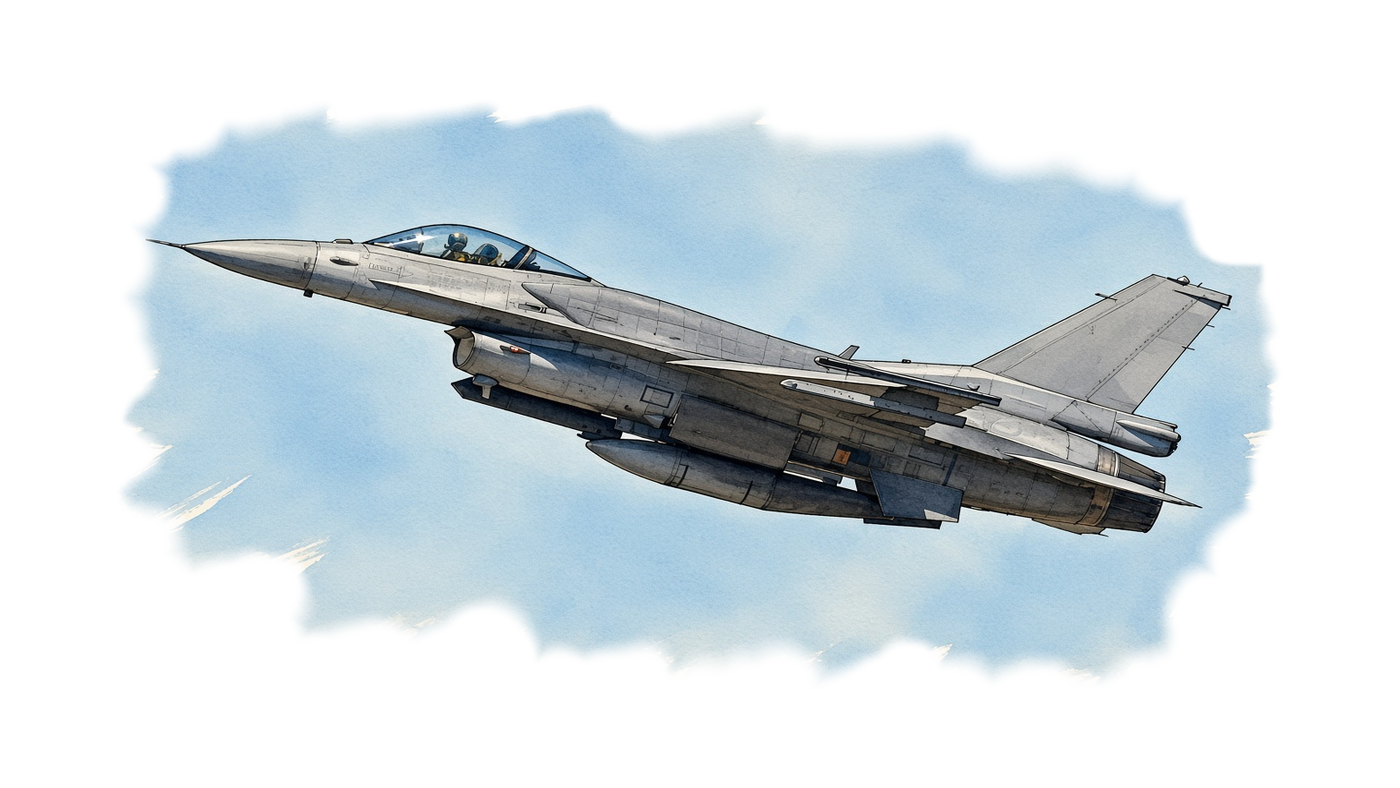
Archive photo: A Polish Air Force F-16 fighter jet in flight, May 2016.Illustration by Agentic Newsgathering, based on a photo by Alan Wilson (CC BY-SA 2.0). The painting carries the same CC BY-SA 2.0 license.
Nobody is hurt as a cruise missile hits a rural area about 31 miles from Ukraine
Three Russian weapons crossed into Poland overnight and came down in the country's southeast. Poland's defense minister, Władysław Kosiniak-Kamysz, said one was a Kh-101 cruise missile that hit a rural area at Nowy Lipowiec, about 31 miles from the Ukrainian border. A second suspected missile fell near Rudnik nad Sanem, and a jet-powered drone crashed near Mołodycz. Polish Prime Minister Donald Tusk said one of the objects exploded. Nobody was hurt and no damage was reported. The objects fell in the same region as Nowa Dęba, where troops from 11 European countries were training for a possible post-war mission in Ukraine. Tusk said, "It appears that we are dealing with an intentional provocation." He said a link to the exercise remains a hypothesis. Poland will ask NATO for more support on the alliance's eastern flank. Polish F-16s, Swedish Gripens and a Dutch refueling plane flew, and Patriot batteries were switched on. NATO Secretary General Mark Rutte called the incursions "grave violations" of Polish airspace and is due in Warsaw on Saturday. They came during a Russian barrage of more than 400 drones and over 110 missiles on Ukraine that killed at least eight people and hit three bridges in Kyiv. The Kremlin has not commented.
What came down, and where
Poland's defense ministry said three objects from Russia violated Polish airspace overnight. The first, a Kh-101 cruise missile, hit a rural area at Nowy Lipowiec in southeastern Poland, about 31 miles from the Ukrainian border. Another suspected missile went down in woodland near Rudnik nad Sanem, and a jet-powered drone crashed near Mołodycz.
"Three Russian objects violated Polish airspace. They fell on Polish land. One exploded. There is no destruction, no casualties," Tusk said.
A farm camera caught the moment of impact. Natalia Szponar, who lives nearby, said she was getting her children ready for school when she heard "a whistling sound. And then a thud — a dull, muffled kind of impact." Air traffic controllers were evacuated at the airport in Rzeszów, a transit point for military aid to Ukraine. Officials said nobody was hurt and no critical infrastructure was damaged.
Why Warsaw calls it deliberate
The objects came down between 30 and 60 miles from the Nowa Dęba training ground, the Guardian reported. A British- and French-led exercise called Koalicja 26.2 was under way there, with thousands of troops from 11 countries in the so-called Coalition of the Willing training for a possible post-war mission in Ukraine.
"We know that what landed on Polish soil came from Russia," Tusk said. "Therefore — and this is not just my own assessment, but also that of our foreign partners, including those within NATO — it does not look like an accident. It appears that we are dealing with an intentional provocation."
"We can't rule out the possibility — and this is a hypothesis — that the provocation was also connected to the exercises taking place in Poland," Tusk said.
Kosiniak-Kamysz said it was "hard to regard it as a coincidence that the time and place of the violation of Polish airspace coincide with the Coalition of the Willing's exercises." He said Poland would ask NATO for more support in securing the alliance's eastern flank. Tusk said Poland "must participate in decisions and discussions regarding the future of Ukraine and security in Europe."
Hours later, defense ministers from Britain, France, Poland, Estonia and Lithuania visited the training ground. Britain's defense secretary, Wes Streeting, called the incursions "yet another example of Russian provocation that is designed to divide Europe and to deter Ukraine's allies from supporting their fight for freedom and democracy."
How NATO responded
Polish F-16s, Swedish JAS 39 Gripen fighters and a Dutch A330 aerial refueling plane flew during the night, and Patriot missile-defense systems around Rzeszów's Jasionka airport and near Świdnik were switched on. NATO and allied ground-based air defenses were put on alert.
Rutte said he had spoken with Tusk about "the grave violations of Polish airspace overnight." He said, "This incident is clearly dangerous — a consequence of Russia's ongoing war against Ukraine," and that the alliance stands "in solidarity with Poland." Tusk said Rutte would visit Warsaw on Saturday.
NATO's founding treaty includes Article 5, the collective defense clause, under which an attack on one of its 32 members is treated as an attack on all.
The Kremlin has not commented on the incident, and Russia's embassy in Warsaw did not immediately respond to a request for comment from Reuters. A day earlier, President Donald Trump told Fox News that Russian President Vladimir Putin "has been landing drones in Poland and a couple of little missiles, by mistake," referring to earlier incidents, according to Politico and AFP. Tusk said he did not always agree with the American interpretation of such incidents and that US officials have access to the debris. "I think that in this particular case, no one will try to pretend anymore that this was just an innocent accident," he said.
A cruise missile also landed in Poland in July during an attack on the western Ukrainian city of Lviv, leaving a crater 33 feet wide, the BBC reported. Moldova said a drone also crossed briefly into its airspace during the latest attack, according to the BBC.
The attack on Ukraine
The incursions came during what Ukrainian President Volodymyr Zelenskyy called "one of the largest attacks" of the war. He said Russia launched more than 400 drones and over 110 missiles, 27 of them ballistic, at energy, rail and logistics targets. Ukraine's air force said 380 drones, 79 cruise missiles and three ballistic missiles were shot down, Reuters reported.
At least eight people were killed, including six in Kyiv and two at a railway station in Lviv. Kyiv Mayor Vitali Klitschko said missiles struck three bridges across the Dnipro River, the Podilsko-Voskresenskyi, Darnytskyi and Pivdennyi crossings. Emergency power cuts were introduced in the western Lviv, Zakarpattia and Ivano-Frankivsk regions, and some residents of five Kyiv districts lost power.
Putin had promised a response after Ukraine struck the bridge linking Russia to occupied Crimea three times in recent days. "I believe that our retaliatory actions … will be far more painful than what the Kiev regime did to the bridge," he said. Zelenskyy wrote that Russia "is trying to compensate for its military and diplomatic impotence with precisely this kind of terror."
852 words · 4 min