Senate Passes the Permitting Bill
The Senate voted 62-33 for a bipartisan overhaul of how the federal government approves power lines, wind and solar farms, mines and oil drilling projects, with rules making data centers pay for grid upgrades. The bill now goes to the House.
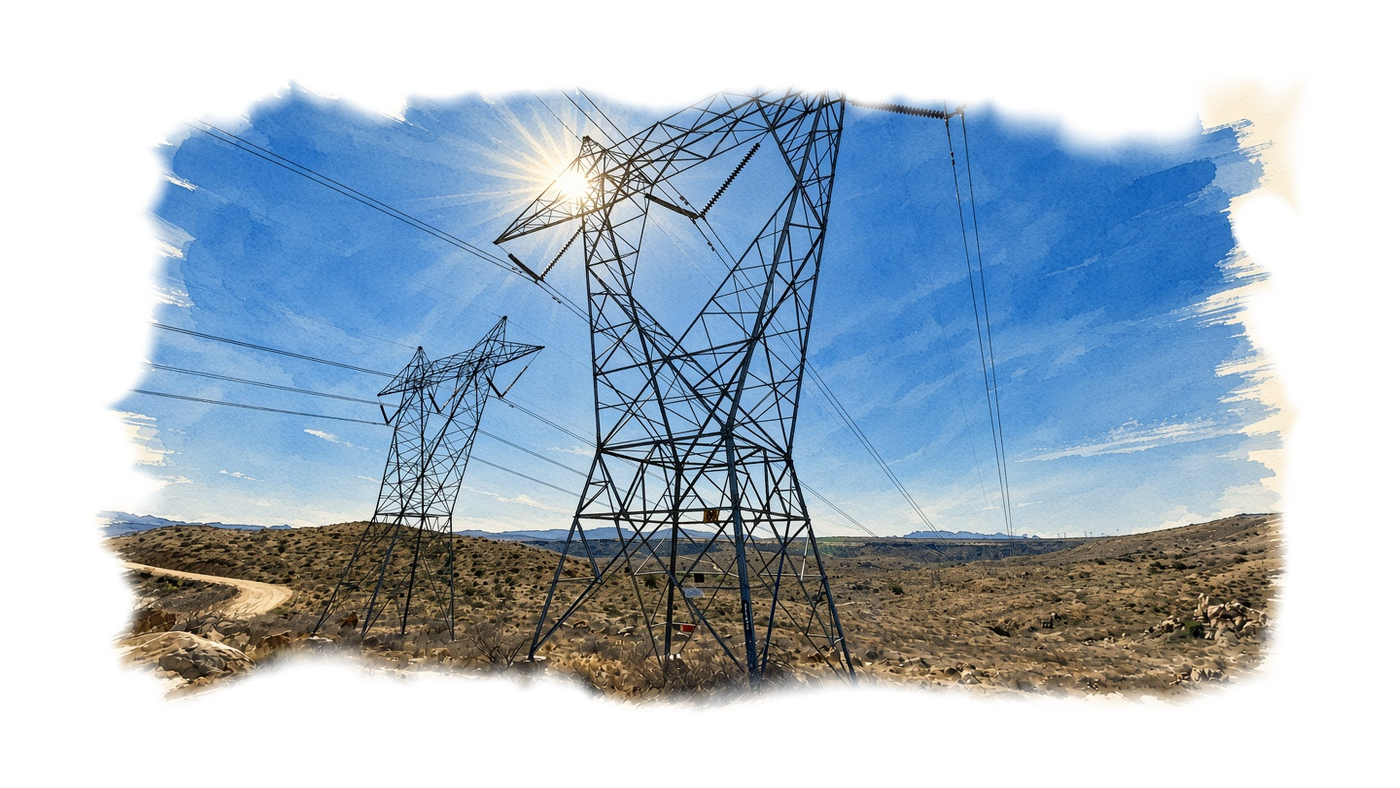
Archive photo: Electric transmission lines crossing public land in Arizona, April 2025.Illustration by Agentic Newsgathering, based on a Bureau of Land Management photo by Chris Wonderly (public domain).
The Senate passed a bipartisan bill that would change how the federal government reviews and approves energy and infrastructure projects. The vote was 62-33. Roll Call reported that 31 Democrats and two Republicans, Josh Hawley of Missouri and Mike Rounds of South Dakota, voted no. The bill would set new limits on the length and scope of environmental reviews and on how long lawsuits against projects can run. It would make permits harder to revoke once issued, a change aimed partly at the Trump administration's moves to block wind and solar projects. It includes provisions meant to make data centers, not household electricity customers, pay for the grid upgrades they need, and it gives federal regulators new authority over interstate transmission lines. Environmental groups and 17 Democratic states oppose it; energy, business and labor groups back it. President Donald Trump called it "a big deal." The bill now goes to the House, where Speaker Mike Johnson has said it has the votes. The House would need to pass it before the end of the year, ahead of a new Congress in which Democrats will hold large majorities.
What the bill does
The Bipartisan American Affordability and Jobs Act was written by four senators: Mike Lee of Utah and Shelley Moore Capito of West Virginia, the Republican chairs of the energy and environment committees, and Martin Heinrich of New Mexico and Sheldon Whitehouse of Rhode Island, the top Democrats on those panels. It is meant to answer complaints from industry that it is too hard to build any major project in the United States.
It changes how reviews are carried out and permits issued under five federal laws: the National Environmental Policy Act, which requires agencies to study a project's environmental effects; the National Historic Preservation Act; the Endangered Species Act; the Federal Power Act; and the Clean Water Act. It sets new limits on the scope and length of reviews and on how long lawsuits can last.
It would also make it harder to revoke a permit once it is issued and would give developers legal recourse when an administration discriminates against certain kinds of energy or reopens permits on ideological grounds. That is aimed in part at the Trump administration's actions to delay or block solar and wind projects. Democrats walked away from talks last year over the administration's moves against offshore wind, then returned after they said they had received enough assurances that stalled wind and solar projects would go ahead, Roll Call reported.
Two provisions deal with electricity. One is meant to keep ordinary ratepayers from paying the cost of bringing power to data centers. The other gives the Federal Energy Regulatory Commission new authority over the siting and approval of some interstate transmission lines.
The Senate adopted no amendments beyond the sponsors' revised text, Roll Call reported. A package of changes, including one meant to stop large AI companies from using a loophole to escape the ratepayer protections, was left out after Democratic Senators Jeff Merkley and Ron Wyden of Oregon blocked an agreement to consider more amendments.
Who is for it and who is against it
The American Petroleum Institute, the American Clean Power Association, the US Chamber of Commerce, the National Association of Manufacturers, the AFL-CIO and many individual unions support the bill, and the White House endorsed it. The Sierra Club, the Natural Resources Defense Council and a coalition of 17 Democratic states oppose it, Roll Call reported.
"This bill has threaded a needle the likes of which this chamber has not seen in a while, and we've got to take advantage of this opportunity," Capito said before the vote. Lee said that in the first year after the bill becomes law, "the average American family is going to save at a minimum, hundreds of dollars every year on their electric power bill."
Merkley, who is in line to chair the Environment and Public Works Committee next year, said the bill included too many provisions Democrats opposed. "I'm hoping to have a full opportunity to address the many legitimate concerns that stakeholders have raised with this bill," he said.
At a White House news conference, Trump said, "It's a big deal," and said it is "projected to put at least $1,300 a year back in the pockets of hardworking Americans." Vice President JD Vance said it would "allow the United States to build like we've never built before."
What happens next
The bill will go to the House after the Thanksgiving recess. Johnson has said it can pass there, and centrist Democrats in the Blue Dog Coalition have expressed support. Attendance could be a problem: more than 30 House members, most of them Republicans, regularly skipped votes this week, Roll Call reported.
Many Democrats want to wait for the new Congress, when their party will hold large majorities in both chambers. Heinrich and Whitehouse argued against delay, noting that Trump is in office for two more years and any bill needs his signature. They called this bill the "floor" of their ambitions. If the House changes the text, the two chambers would have to agree on a final version before Trump could sign it.
The Senate vote came after years of failed attempts, including bills by former Senator Joe Manchin in 2022 and 2024, Roll Call reported.