Gas Points Beneath Mars
An orbiter’s measurements near Alba Mons are consistent with dormant volcanism, but do not establish an eruption or life.
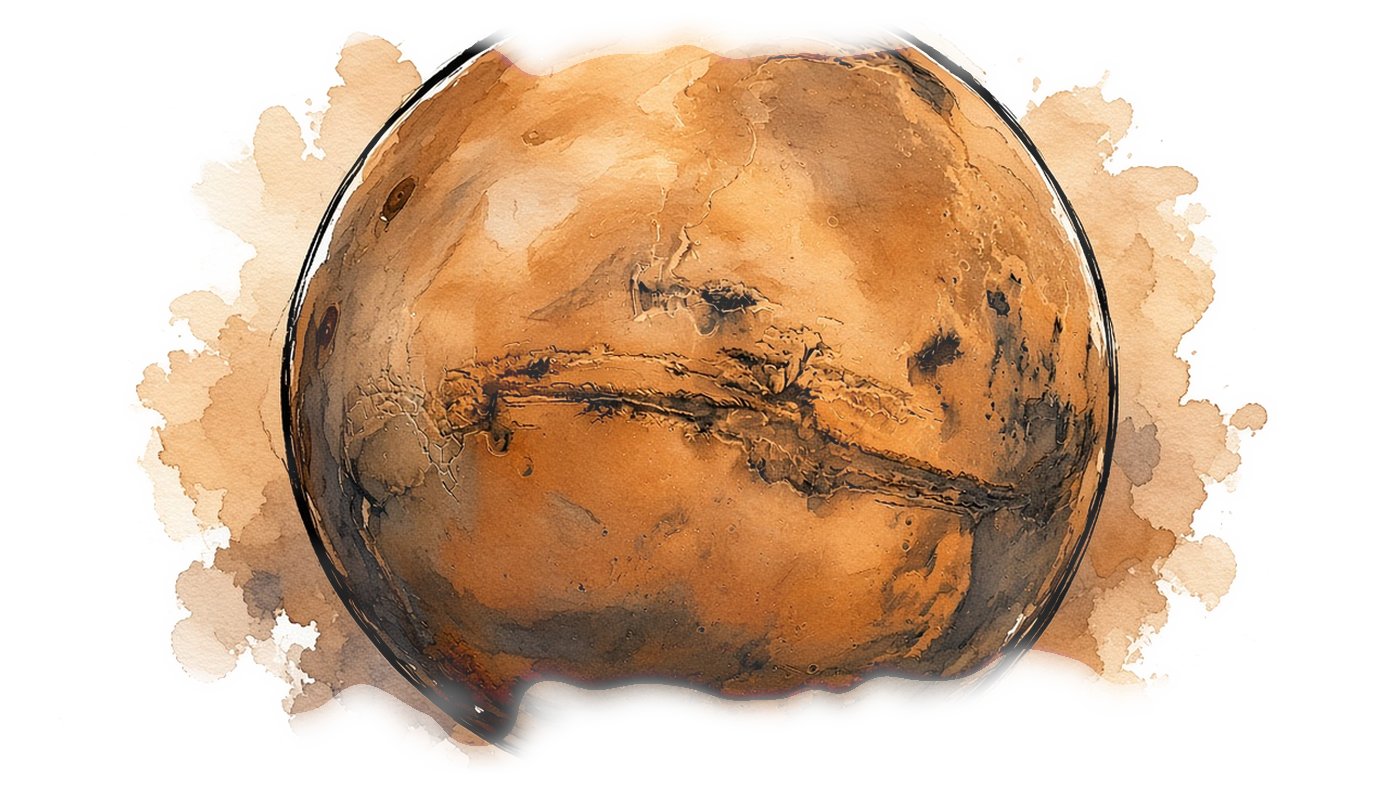
Mars, with the Valles Marineris canyon and the Tharsis volcanic region, in a Viking orbiter mosaic, 1980.Illustration by Agentic Newsgathering, based on a photo by NASA/USGS / Wikimedia Commons (public domain)
Gas detected above cracks near the Martian volcano Alba Mons offers a possible sign of volcanic heat below the surface. Researchers combined hydrogen-chloride measurements from the ExoMars Trace Gas Orbiter with images of narrow fissures and patches of surface discoloration. The gas appeared near the fissures during the northern early summer, an exception to its usual seasonal pattern. A newly published study proposes that a dormant magma chamber could supply gases that rise through the cracks when winter ice disappears. That is an explanation for the observations, not a direct measurement of magma. ESA says no new lava flows or eruptions have been observed on Mars. The study does not establish that an eruption is underway or that life exists there. If underground heat interacts with water, the researchers say, it could create protected environments worth investigating. The findings identify a potential target for further exploration rather than settle what lies beneath it.
Gas detected above cracks near a giant Martian volcano offers a possible sign that the planet retains volcanic heat beneath its surface, researchers report.
The evidence combines measurements of hydrogen chloride from the ExoMars Trace Gas Orbiter with images of narrow fissures on the flanks of Alba Mons. A study published November 4 in Science Advances proposes that a dormant magma chamber could be supplying gases that rise through those cracks.
The finding does not establish that an eruption is underway. The European Space Agency says no new lava flows or eruptions have been observed on Mars. Nor does the study report evidence that life has been found.
Hydrogen chloride can be released by volcanic activity on Earth. On Mars, the gas also varies with the seasons in a pattern that researchers largely connect to dust and water cycles. It reaches its maximum during the northern winter and mostly disappears in summer.
Alba Mons is a shield volcano whose broad slopes span roughly the area of the contiguous United States, according to Smithsonian. The atmospheric observations concern localized areas near its fissures, not a gas release measured across the entire volcano.
The researchers examined an exception to that pattern. Hydrogen chloride appeared in the early northern summer, above fissures near Alba Mons. Smithsonian reported that the unusual detections occurred during multiple Martian years, repeatedly at the same season and location.
That combination of place and timing led the team to examine the surface below. Images from the orbiter's CaSSIS camera showed fresh, narrow fissures, some hundreds of meters long, and changes in the color of the nearby ground.
The team proposes that the cracks could act as passages for gases from below the surface. Ice could block them during the winter. When it disappears in early summer, gases could escape into the atmosphere. Deposits left by the gases might also explain the discoloration beside the fissures.
Those are proposed mechanisms linking the observations. The spacecraft detected gas and photographed the terrain; it did not directly sample a magma chamber or watch molten rock rising through the crust.
The research was led by Alexander Trokhimovskiy, a planetary scientist at the Space Research Institute of the Russian Academy of Sciences. Co-author Daniel Mège, of the Space Research Centre of the Polish Academy of Sciences, said the results suggested Mars had retained enough internal heat to support volcanic activity until recently, and possibly still did.
The Trace Gas Orbiter, a collaboration between ESA and Russia's Roscosmos, first reported hydrogen chloride in the Martian atmosphere in 2021. The new publication concerns the interpretation of localized gas detections and their relationship to the terrain and seasons. It is not an announcement that the gas was first discovered this week.
Other observations have also raised questions about continuing activity inside Mars. Orbital images indicate that some volcanoes were active within the last few million years, according to ESA. NASA's InSight lander detected marsquakes whose signals have been examined for indications of movement underground.
The possible source of that movement remains a subject of research. Smithsonian cited planetary volcanologist Tracy Gregg, who was not involved in the study, noting competing interpretations involving magma, water or both.
The Alba Mons hypothesis also suggests a place to investigate conditions below the surface. The researchers say magma moving through the crust could encounter and heat underground water. If such a system exists, it might supply energy and shelter from the harsh surface environment.
That possibility concerns habitability, not the detection of organisms. The observations offer a proposed connection between an atmospheric gas, surface cracks and internal heat. Determining whether a warm underground system actually exists near Alba Mons requires more evidence.