Math Pulls a Hidden Planet Out of Webb Data
A Northwestern and Caltech team built a digital twin of the James Webb Space Telescope's main camera, subtracted starlight up to 15 times more cleanly than standard methods, and found a giant planet that two-year-old images had missed.
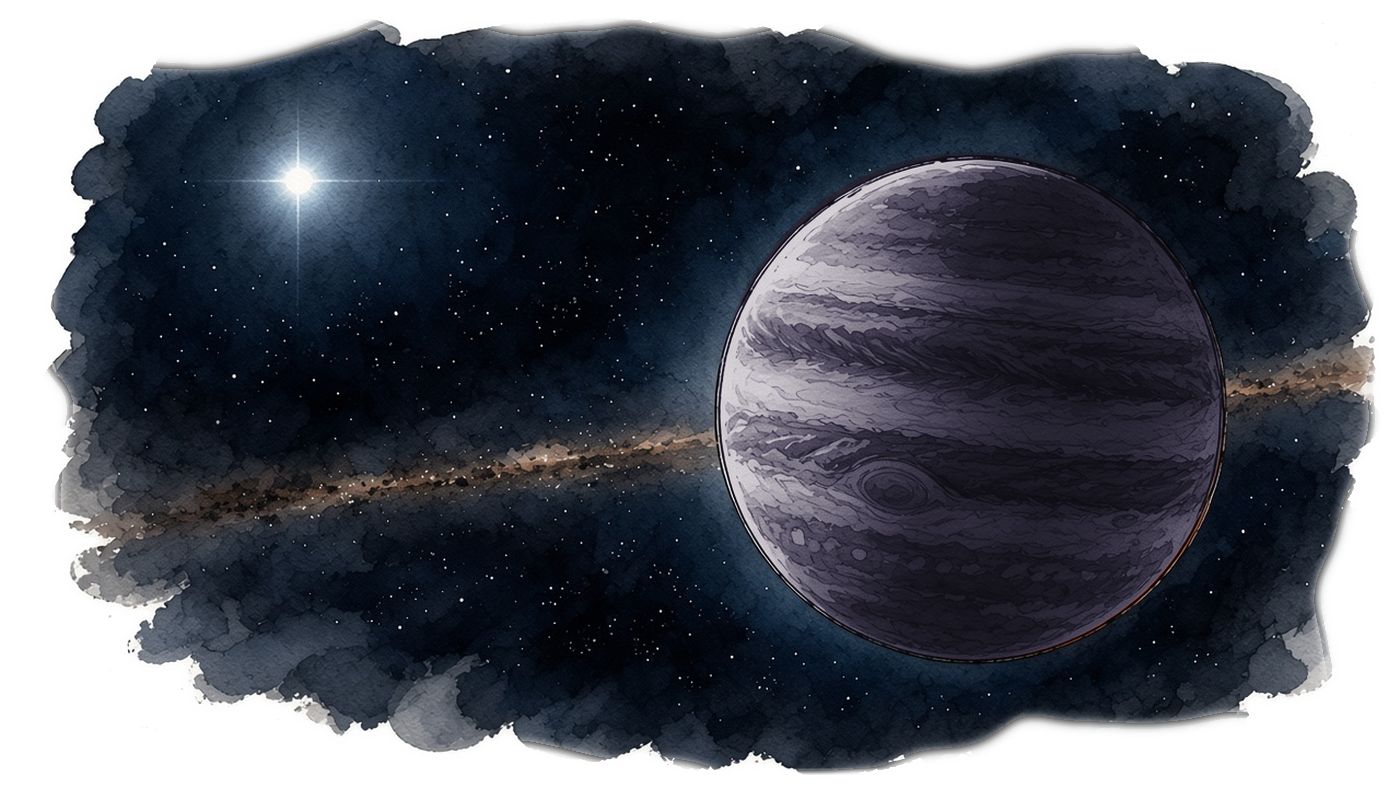
An artist's impression of the planet 51 Eridani b, a young Jupiter-like gas giant orbiting far from its bright star, November 2026.Illustration by The Good Times
Astronomers have found a way to scrub a star's glare out of James Webb Space Telescope images precisely enough to reveal planets the telescope had already photographed without anyone seeing them. The method, called FLIP, builds a digital copy of Webb's Near Infrared Camera and tunes millions of settings until the copy reproduces the tiny wobbles and distortions in the real telescope. The team then subtracts the simulated starlight. Tested on archived Webb observations of three stars, it detected faint planets two to 15 times better than the standard technique. In images of the star 51 Eridani taken two years ago, it recovered the giant planet 51 Eridani b at a wavelength where carbon dioxide absorbs light and where the usual processing had found nothing. The study, led by Northwestern graduate student Rodrigo Ferrer-Chavez with Caltech's Katie Bouman, was published in Nature. The team says the method can work on other telescopes and could ease the stability demands on NASA's planned Habitable Worlds Observatory, meant to photograph Earth-like planets.
Planets around other stars are very hard to photograph because the star outshines them. Even a bright young giant planet can be 100,000 times fainter than its star, and an Earth-like planet around a sun-like star is about 10 billion times fainter. Telescopes use instruments called coronagraphs to block most of the starlight, and astronomers then process the images to remove what leaks through.
For about 20 years the standard approach has been to photograph a different star and subtract that image as a reference, said Jason Wang, an assistant professor of physics and astronomy at Northwestern and a co-author. No telescope stays perfectly still, though. Tiny temperature changes can make a mirror grow or shrink by a picometer, and the motors in Webb's cryocoolers can make mirrors vibrate. So the reference never matches the real observation exactly, and the leftover glare can hide a planet.
FLIP, short for Physics-based Learning for Imaging Planets, models how light travels through Webb's mirrors to its detectors. The researchers used the optimization tools that are used to train AI models to adjust millions of parameters in that model until it matched each real observation, then subtracted the simulated glare. "We used the same computational tools that researchers use to train AI models, but we did not actually use AI," Wang said. "Because we already know the physics, we don't need AI to understand what's happening."
"You basically see the glare of the star disappearing in very bizarre ways," Ferrer-Chavez said. "It gets dimmer and very deformed until at the end you get a pretty clean image and, if you're lucky, there's a blob there, which is a glowing planet."
The team reanalyzed Webb observations of HIP 65426 and 51 Eridani, which have known planets, and TYC 5899, which has none. FLIP beat conventional processing across them, improving sensitivity by two to 15 times. 51 Eridani b had been found earlier with ground-based telescopes, but standard processing could not pick it out of Webb's images at 4.3 microns, a wavelength where carbon dioxide in the planet's atmosphere absorbs light. FLIP detected it there with high statistical confidence. "This is real data in a real scenario. It was science left on the table," Wang said.
Readings at that wavelength can tell astronomers about a planet's atmosphere and makeup. The team is now going back through all the coronagraph images Webb has taken, which number in the hundreds, Science reported. "We'll see if we actually can find new planets," Ferrer-Chavez said. Bruce Macintosh, director of the University of California Observatories, who was not part of the study, said, "It's hard to argue with results," and expects the technique to become routine for Webb. Sasha Hinkley of the University of Exeter told the journal it could also spare astronomers from spending telescope time on reference stars. "We could cut our observing time into a fraction of what it is now and observe many more stars and observe many more planets, and get better images, too," he said.
The team plans to apply FLIP to NASA's Nancy Grace Roman Space Telescope and to ground-based telescopes. NASA's proposed Habitable Worlds Observatory, meant to photograph Earth-like planets around sun-like stars and look for signs of life, may need to hold its optics steady to within a picometer, roughly 100 to 1,000 times steadier than Webb, Northwestern said. Correcting for wobble after the fact could ease that requirement.
"Sometimes, the key to seeing something new isn't just building a better instrument but finding a better way to make sense of the light it collects," Bouman said. The work was funded by the Space Telescope Science Institute, the Sloan Foundation, an Amazon AI for Science award and the National Science Foundation, Caltech said, and co-authors include researchers at MIT and the Space Telescope Science Institute.