Israel Certifies Its Election Result
Election officials rejected Prime Minister Benjamin Netanyahu's fraud claims, leaving his bloc short of a majority as President Isaac Herzog opens coalition talks.
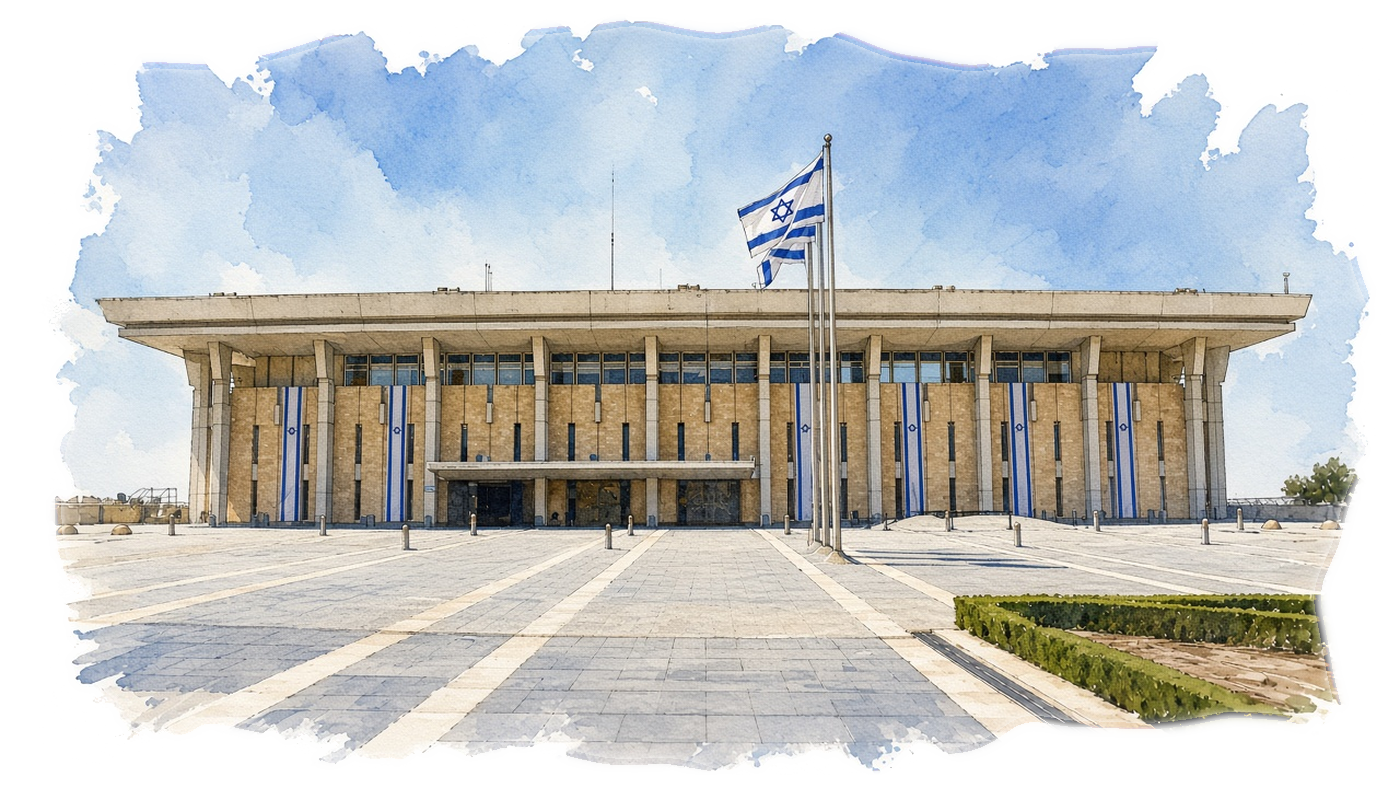
The Knesset, Israel's parliament, in Jerusalem, July 2022.Illustration by The Good Times, based on a photo by Clema12 / Wikimedia Commons (CC BY-SA 4.0). The painting carries the same CC BY-SA 4.0 license
Israel's Central Elections Committee certified the results of the parliamentary election, saying a review of 9,069 polling stations found no irregularities that compromised the vote or changed its outcome. The result leaves Prime Minister Benjamin Netanyahu's bloc with 53 of the 120 seats, short of the 61 needed to govern. Gadi Eisenkot's opposition bloc won 48, and two parties outside both blocs won 19. Netanyahu and his allies had claimed, without evidence, that the election was stolen. The committee's chairman, Supreme Court Justice Noam Sohlberg, handed the results to President Isaac Herzog and said that "election results, as lawfully determined, are binding on us all." Representatives of Netanyahu's Likud party and its ally Shas abstained from the certification vote. Herzog is holding two days of consultations with party leaders and will then give one candidate 28 days, with a possible 14-day extension, to build a coalition. If no one can form a government, Israel would hold another election early next year.
The committee said in a statement that "the review found no evidence of irregularities that compromised the integrity of the election or affected its results." Its acting director general, Dean Livne, said every complaint had been examined individually. Sohlberg said some suspicions were still under investigation but "do not cast doubt on the election as a whole or justify delaying the election results." He rejected a Likud demand to discuss the results before certifying them, writing that no party, "however distinguished or senior," could hold up their publication.
In the committee's five-member presidium, representatives of Yesh Atid and Blue and White voted to ratify the results, Likud and Shas abstained, and Sohlberg cast the deciding vote, Al Jazeera reported. Likud lawmaker Amit Halevi resigned from the committee, alleging that some lawmakers "bought their seats with bribe money." Qatar has rejected claims that it funded parties in the election, calling them "disinformation."
Attorney General Gali Baharav-Miara said she blocked a Shin Bet request to question four opposition politicians because she had been shown no evidence. "In a country governed by the rule of law, neither citizens nor elected officials can be interrogated without evidence that justifies doing so," she said. The Shin Bet chief, David Zini, was appointed by Netanyahu.
Eisenkot, a former military chief, accused Netanyahu of using the security services against political opponents. "The employees of the Ministry of Defense, law enforcement and the civil service in Israel are servants of the state, not the king," he said.
Herzog asked both sides to accept that "not every commitment and promise can be fulfilled" and to avoid another election. After his consultations, he gives one candidate 28 days to form a coalition, with a possible 14-day extension. If no one succeeds, Israel would hold another election early next year. Netanyahu needed 58 days to form a government after the November 2022 election. Israel held five elections between 2019 and 2022.