Oil Falls Most Since July
Brent crude dropped 7.6% after Iran said its leaders had cleared the government to settle the war through talks, and President Trump twice said "No" when asked whether he would strike Iran after the midterms.
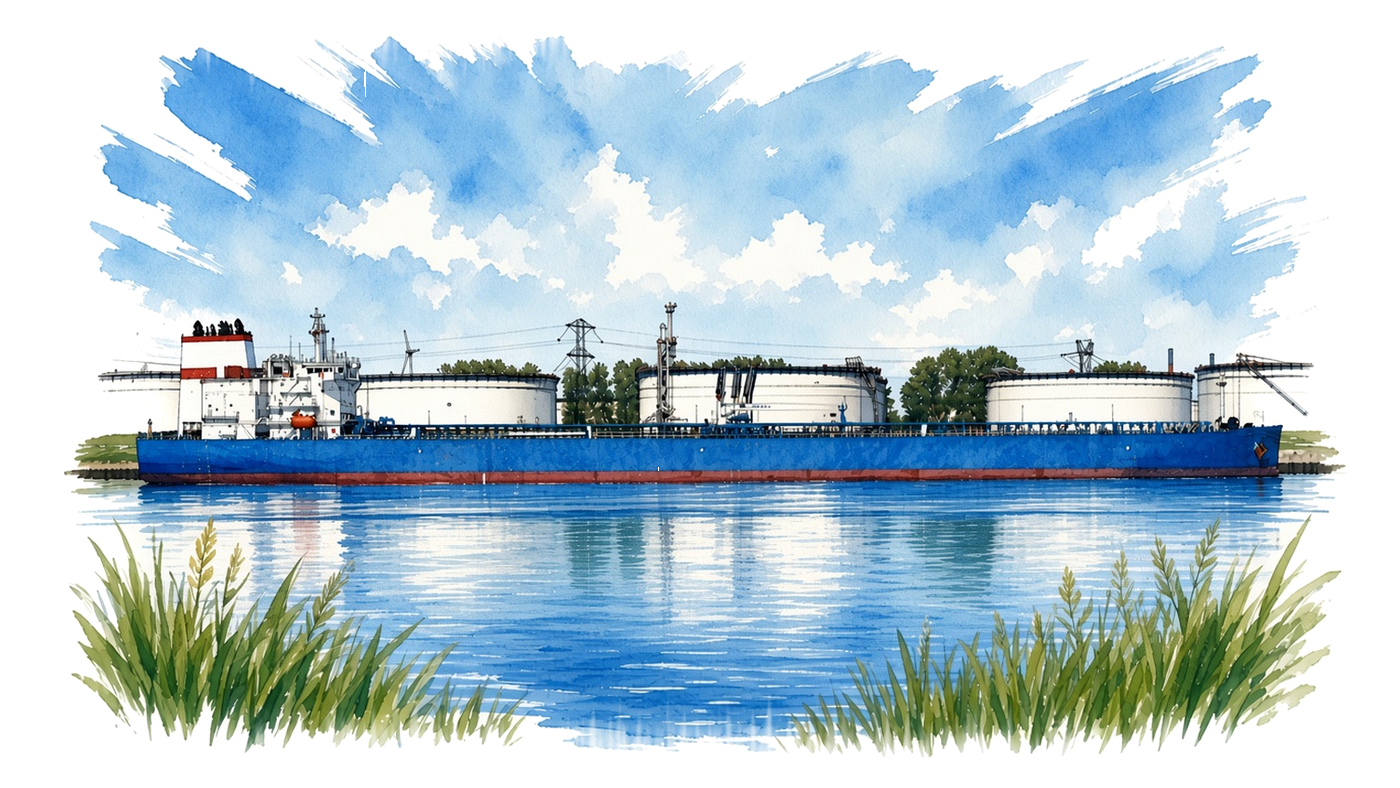
A crude oil tanker moored by storage tanks in the Port of Rotterdam, May 2026.Illustration by The Good Times, based on a photo by Alfvanbeem / Wikimedia Commons (CC0)
Oil had its biggest one-day fall since late July as Iran and the United States both signaled that talks to end their eight-month war will go on. Brent crude, the world benchmark, fell 7.6% to settle at $104.77 a barrel, and U.S. crude fell more than 7% to $96.46. Iranian President Masoud Pezeshkian said, through the state news agency IRNA, that Supreme Leader Mojtaba Khamenei had "granted the government certain authorities" to resolve problems through dialogue. Iran's Foreign Ministry said its September plan could now be carried out in two days instead of seven if Washington meets its conditions, among them lifting sanctions and ending the U.S. naval blockade of Iranian ports. Asked by NBC News whether he was considering striking Iran after the midterm elections, Trump twice answered "No." He told reporters oil was down $10 and would go lower. Qatari mediators flew to Tehran in the evening to discuss a draft agreement. Nothing has been signed, and the blockade remains in place.
Brent crude fell 7.6% to $104.77 a barrel and West Texas Intermediate, the U.S. benchmark, fell to $96.46, a drop NBC News put at 7.3% and CNBC at 7.4%. For both, it was the largest one-day percentage drop since July 27.
Iran's state news agency IRNA quoted President Masoud Pezeshkian as saying that Supreme Leader Mojtaba Khamenei had "granted the government certain authorities" to seek a solution through dialogue.
Foreign Ministry spokesman Esmaeil Baghaei said the seven-step plan Iran put forward in September remains the basis of the talks but could now be carried out within two days instead of seven. Iran's conditions include lifting sanctions and ending the U.S. naval blockade of its ports, and Foreign Minister Abbas Araghchi said Tehran also wants the United States to cut its military presence in the region. Baghaei said the outcome depends on Washington. Deputy Foreign Minister Kazem Gharibabadi went to Doha, where Qatar is mediating, and Qatari mediators traveled to Tehran in the evening to discuss a draft agreement with Araghchi, Reuters and Axios reported.
After the oil market closed, NBC News asked Trump whether he was considering striking Iran after the midterms, and he twice said "No." Reuters also reported his answer. Earlier he told reporters, "Oil today is down $10, and it's going to go down a lot further because we're winning with Iran, easily winning." He later wrote on social media, "Iran wants a settlement, as soon as possible. It could happen!" Secretary of State Marco Rubio said Trump "hasn't made a decision" on new strikes and that Washington would prefer a peaceful outcome.
The Strait of Hormuz has not reopened, and the U.S. blockade of Iranian ports remains in place. No agreement has been signed, and Iran says the strait stays shut until its conditions are met. Whether this drop holds depends on talks that have not yet produced a deal.