Trump Invokes Defense Production Act for Oil
President Trump declared U.S. oil production, refining, pipelines, storage and marine terminals essential to national defense, letting the federal government buy, commit to and finance projects that expand them under a Cold War-era law. The memo names no project, company or dollar amount, and it does not set prices or release oil from any reserve.
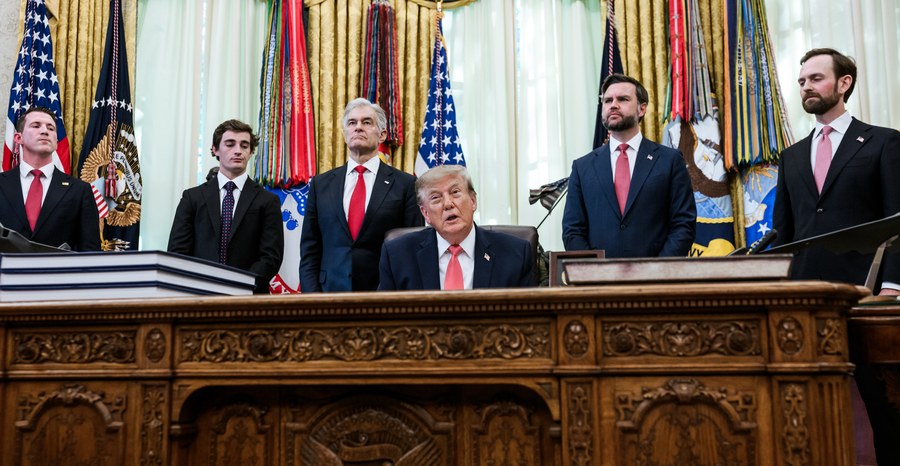
The federal government can now pay to expand American oil drilling, refining, pipelines and fuel storage under the Defense Production Act, a Cold War-era law. In a memorandum to the Secretary of War, President Trump determined that domestic petroleum production, refining and logistics, including exploration and production, pipelines, storage and marine terminals, are essential to the national defense.
The memo authorizes purchases, purchase commitments and financial support to expand that capacity, waives the law's usual preconditions for this purpose and directs the Secretary of War to carry it out. It says industry cannot build what is needed in time on its own because of constrained financing, long lead times, permitting and infrastructure bottlenecks, and supply-chain limits.
It names no project or dollar amount. Last week Vice President JD Vance said the administration would use the law to expand a Texas refinery owned by Delek US Holdings, and a law Trump signed last year set aside $1 billion in Defense Production Act money for energy projects.
Crude and diesel prices have surged since the United States and Israel attacked Iran at the end of February. The United States was already the world's largest crude producer, averaging about 13.6 million barrels a day in 2025.
President Trump has declared American oil production, refining and fuel logistics essential to the national defense, opening the way for the federal government to pay for new capacity under the Defense Production Act.
The presidential determination, addressed to the Secretary of War, covers "exploration and production, gathering and transmission pipelines, storage, and marine terminals." It finds that without presidential action, "United States industry cannot reasonably be expected to provide these capabilities" in a timely manner "due to constrained financing, long lead times, permitting and infrastructure bottlenecks, and supply chain limitations."
What the memo allows
Section 303 of the Defense Production Act lets the president use purchases, purchase commitments and financial support to build up industrial capacity the military depends on. The memo finds those tools are "the most cost-effective, expedient, and practical alternative methods for meeting this need." It waives the law's usual preconditions for the purpose of expanding oil capacity and directs the Secretary of War to carry it out, "including making necessary purchases, commitments, and financial instruments to enable these projects," and to publish the determination in the Federal Register.
The memo rests on the national energy emergency Trump declared in Executive Order 14156 on January 20, 2025. "Petroleum fuels the Nation's Armed Forces, industrial base, and crucial infrastructure," it says. Any earlier order that conflicts with it is superseded to the extent of the conflict.
What it does not do
The memo does not name a company, a project or a sum. It does not set a price, order anyone to produce or release oil from any reserve. Last week Vice President JD Vance said the administration would use the law to expand the capacity of a Texas refinery owned by Delek US Holdings, and legislation Trump signed last year included $1 billion in Defense Production Act funding for energy projects deemed critical to national security.
Why fuel is on the table
Prices for crude oil and diesel have surged since the United States and Israel attacked Iran at the end of February. The war has limited energy shipments around the world, and Ukrainian strikes on Russian refineries have added to fuel shortages. The United States averaged about 13.6 million barrels of crude a day in 2025, the most of any country.