Satellite Prints a Beam in Open Space
A small satellite built by the European startup Orbital Matter 3D-printed a half-meter beam while exposed to the vacuum of space and used it to unfold a solar array, a first step toward spacecraft that build their own large structures in orbit.
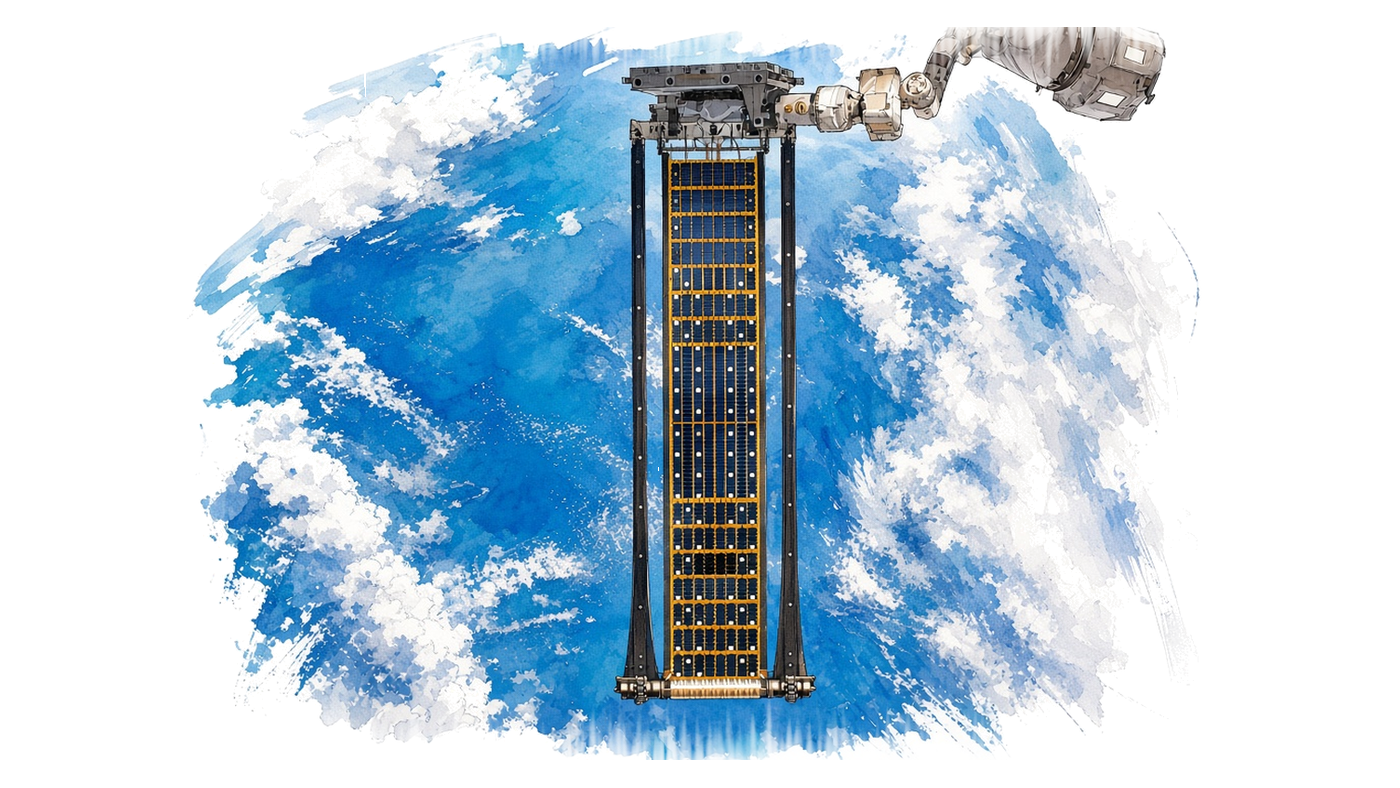
A roll-out solar array unfurled in orbit during a test on the International Space Station, June 2017.Illustration by The Good Times, based on a NASA photo (public domain)
A small satellite called Replicator 2 has 3D-printed a rigid beam half a meter long in open space and used it to deploy a flexible solar array, its builder, Orbital Matter, said. Executives called it a first for a free-flying spacecraft. Earlier 3D printing in orbit took place inside the pressurized cabin of the International Space Station. The satellite launched on a SpaceX rideshare mission in July carrying four printers. Each extrudes coils of resin that an ultraviolet light cures into a solid cylinder. One of the two printers meant to deploy a solar array failed, but the beam from the other unfolded the array. Today's big solar panels and telescope mirrors are folded to fit inside a rocket and opened in orbit. Building them in space could let satellites grow larger, generating more power and shedding more heat, which matters for proposed data centers in orbit. "Replicator 2 is the first proof that we can simply build the array in space, at whatever size the mission demands," said Jakub Stojek, the company's chief executive. Its engineers think 100-meter beams are feasible.
Replicator 2 carried four of Orbital Matter's printers into low Earth orbit, the company said. It launched on July 7. Each printer builds a rigid, cylindrical beam by pushing out coils of resin and curing them with ultraviolet light, a process the company compares to cement and water. In August the company released footage from an onboard camera of its first print in open space, where there is no air, no gravity to settle the material and wide temperature swings.
The latest step was a full beam half a meter long that deployed a flexible solar array, TechCrunch reported. Two of the four printers were designed to deploy arrays. An anomaly caused one of them to fail, but the beam built by the other pushed its array open. In September the company had described plans for the two printers to build beams 1 meter long in unison, with the folded panels between them opening accordion style, Aerospace America reported.
"That's why we put so many printers on this single satellite," said Robert Ihnatisin, the company's chief technology officer. "We preferred to learn in orbit and adapt the software as needed rather than waste years testing every possibility on the ground."
Large structures in space are now built like origami. Solar arrays and telescope mirrors are folded to fit inside the nose cone of a rocket and unfolded once in orbit, a demanding engineering task. Spacecraft that print their own beams could carry bigger arrays to make more electricity and bigger radiators to shed more heat, both limits for satellites meant to work as data centers in orbit. Advenit Makaya, an advanced manufacturing engineer at the European Space Agency, told Aerospace America in September that folding structures "will hit a certain ceiling" because of the size of rocket fairings. NASA funded a project with the company Redwire that printed structural beams in a vacuum chamber in 2023, but it never flew.
The length of a beam is limited by how much resin the satellite carries. Orbital Matter's engineers believe 100-meter beams are feasible. SpaceX's Starlink V2 satellites, among the most powerful mass-produced satellites, use solar arrays about 20 meters long.
The company, founded in 2022 and based in Warsaw and Berlin, works with the European Space Agency and Thales Alenia Space, which collaborated on Replicator 2. It plans a larger demonstration mission in 2028 meant to deploy a solar array producing 5 kilowatts, as a step toward arrays of more than 100 kilowatts per wing by 2030. Satellite builders are considering its printer-assisted deployment system to extend solar panels, antennas and other parts.