Europe's Gas Tops €100
With storage near record lows and Gulf gas disrupted by the Iran war, Europe's benchmark gas price is at its highest in almost four years, and the weather this winter will shape what comes next.
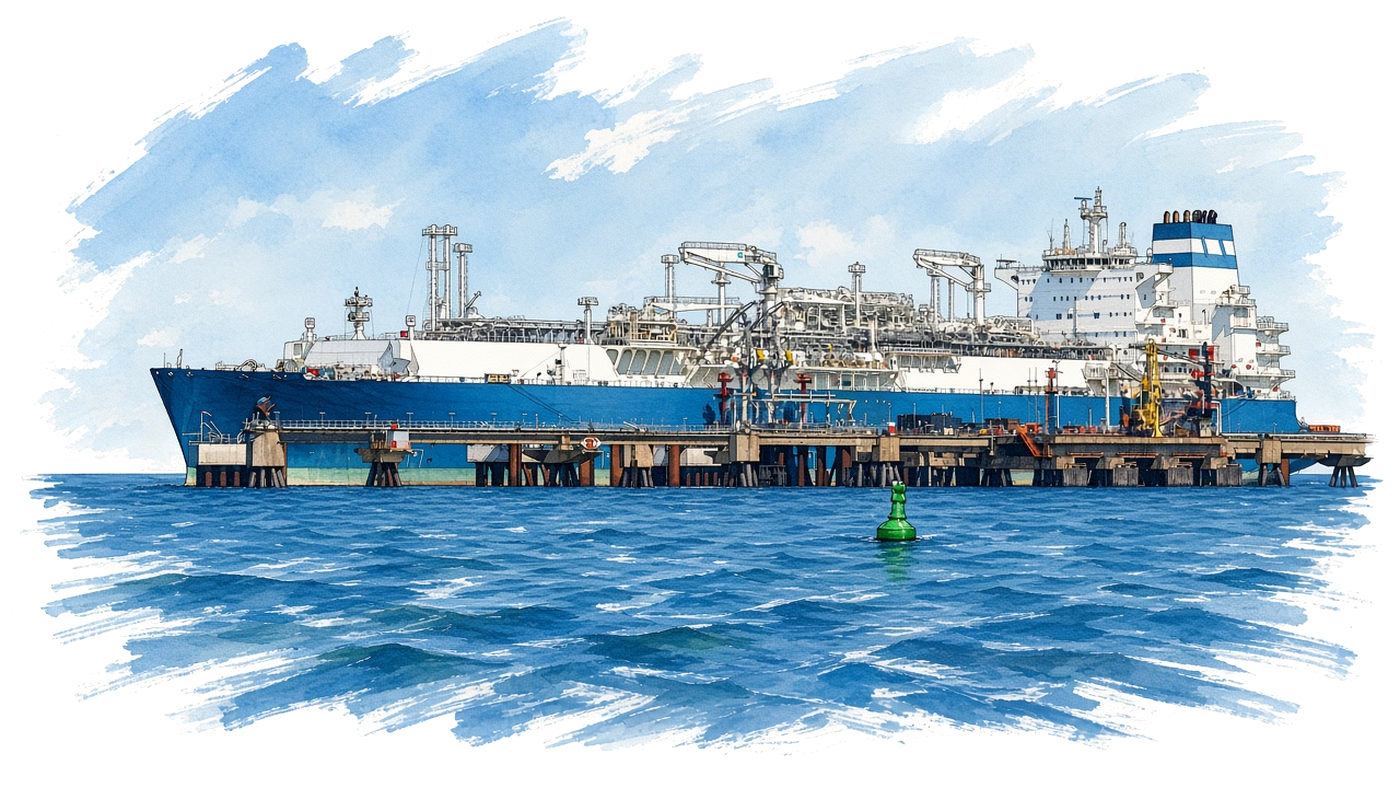
The floating LNG terminal ship Höegh Esperanza at its jetty in Wilhelmshaven, Germany, June 2024.Illustration by The Good Times, based on a photo by JoachimKohler-HB / Wikimedia Commons (CC BY-SA 4.0)
Europe's benchmark natural gas price, the Dutch TTF contract, rose above €100 per megawatt-hour for the first time since December 2022, its highest level in almost four years. That is roughly triple where it stood before the Iran war, though still far below the record of about €340 set in August 2022. The war has disrupted shipments of liquefied natural gas from the Gulf, mainly Qatar, and Europe could not refill its stores over the summer. EU storage is about 75% full, depleted to record lows. EU Energy Commissioner Dan Jørgensen said Europe faces "another energy crisis" and a difficult winter. Analysts say the weather now matters most: a cold winter would raise demand and set Europe competing with Asia for spare cargoes. "We actually need quite a warm winter to make it through unscathed," said Peter Taylor of Macquarie. The United States, with its own shale gas and LNG, is less exposed. BlackRock estimates the energy shock has cut GDP by about 0.5% in Europe and 0.1% in the U.S.
Europe's benchmark natural gas contract, the Dutch TTF, rose above €100 per megawatt-hour for the first time since December 2022, its highest level in almost four years. The price is roughly triple its level before the Iran war began, though it remains far below the record of about €340 set in August 2022, after Russia's full-scale invasion of Ukraine.
Why prices are rising
The war has disrupted shipments of liquefied natural gas, or LNG, from the Gulf, mainly from Qatar, as traffic through the Strait of Hormuz has been interrupted. Europe could not refill its storage over the summer, and EU stores now stand at about 75% full, depleted to record lows as the heating season begins.
"Once again, due to geopolitical turbulence, Europe faces another energy crisis," EU Energy Commissioner Dan Jørgensen told reporters in Brussels hours before the price crossed €100. "We know that this winter will be difficult for European citizens and for our economy in general."
"As winter approaches, Europe has less of a storage cushion than needed and fewer options to quickly replace disrupted supply," said Mathieu Utting, a gas and LNG analyst at Rystad Energy.
The weather question
Analysts and the industry say the next move depends heavily on temperature. A cold winter would raise demand for heating and push Europe to compete with Asia for spare LNG cargoes, which could send prices higher. "We're in a situation where we actually need quite a warm winter to make it through unscathed," said Peter Taylor, head of commodity desk strategy at Macquarie. If cold weather comes, he said, Europe could find itself competing "with Asia for molecules," with "a lot of upside" for prices.
Who is exposed
Europe and much of Asia are more exposed to gas price shocks than the United States, which produces its own shale gas and exports LNG. "The energy shock has uneven effects," BlackRock analysts said, estimating it has reduced GDP by about 0.5% in Europe and 0.1% in the U.S.