Physicists Report Evidence of a Third Kind of Magnetism
A SLAC-led team used polarized X-rays to show that manganese telluride carries a signature of altermagnetism, a class of magnet that could lead to sturdier, lower-power electronics.
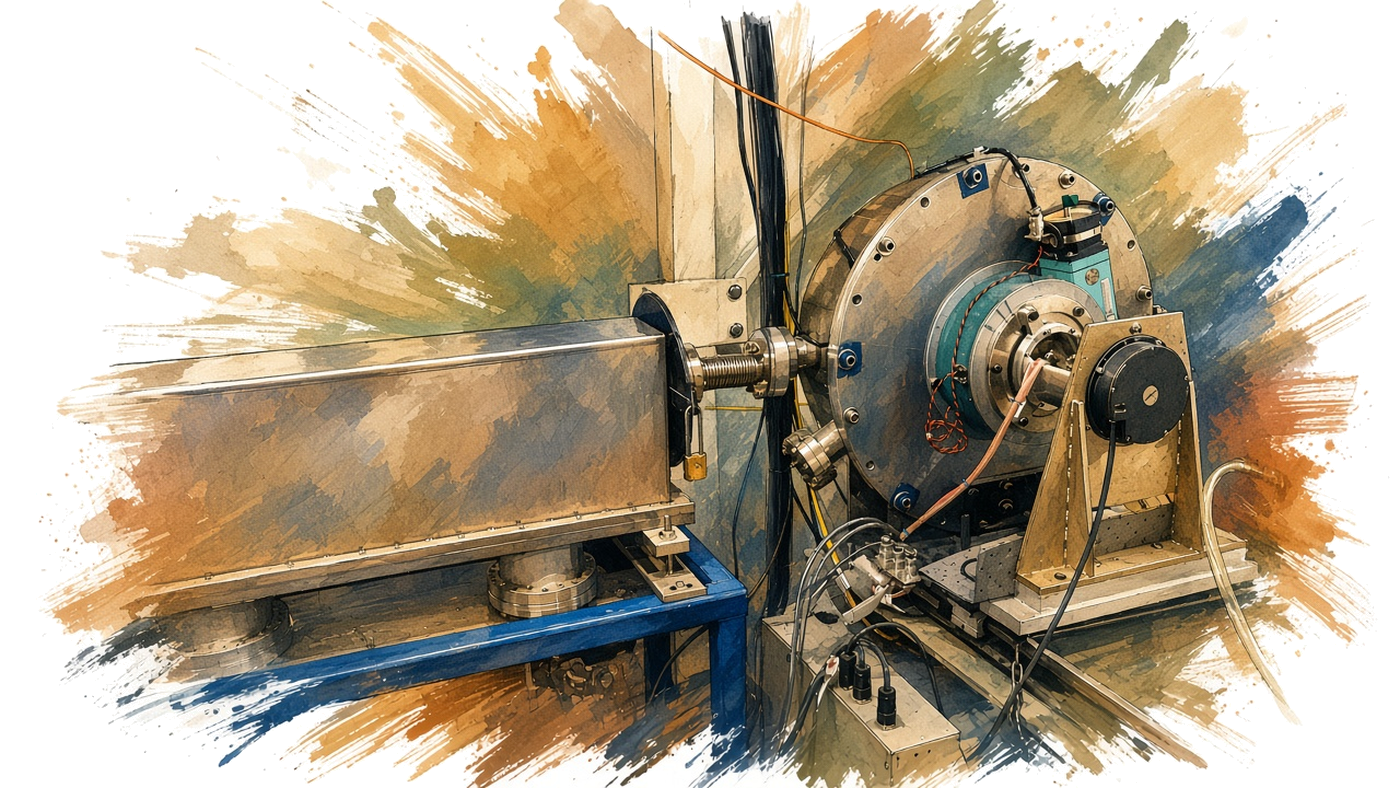
An X-ray beamline optics hutch at the Stanford Synchrotron Radiation Lightsource at SLAC, October 2014.Illustration by The Good Times, based on a photo by XanaG / Wikimedia Commons (CC BY-SA 4.0).
A team led by the Department of Energy's SLAC National Accelerator Laboratory reports in the journal Science direct experimental evidence of altermagnetism, a third kind of magnetism alongside ferromagnetism and antiferromagnetism. In a ferromagnet, like a refrigerator magnet, the spins of electrons line up. In an antiferromagnet, they alternate and cancel out. Altermagnets alternate like antiferromagnets but behave in some ways like ferromagnets. The team studied manganese telluride, a material long treated as an antiferromagnet, at the European Synchrotron Radiation Facility in Grenoble, France. They shone left- and right-handed circularly polarized X-rays at it, and the material responded differently to each, a sign of "handedness," or chirality, in its magnetic waves that fits altermagnetism. The researchers say such materials could be used in spintronics, electronics that use an electron's spin as well as its charge, for memory and quantum technologies.
Two kinds of magnet, then three
For decades physicists recognized two types of magnetism that occur in materials on their own, SLAC and the ESRF said. Altermagnetism, first proposed in 2022, has properties of both, according to SLAC and the ESRF, and Science's editors describe it as a recently identified category of magnetic materials.
The experiment
The team scattered circularly polarized X-rays from manganese telluride and compared how it responded to left- versus right-handed light, finding a chiral signal that should not appear in a conventional antiferromagnet, SLAC and the ESRF said. The paper calls the excitation a "chiral altermagnon" and says its behavior matches the symmetry predicted for an altermagnet. "Chiral materials scatter left-handed polarized X-ray beams differently than they do right-handed beams," said lead author Daniel Jost of SLAC, according to SLAC and the ESRF. The first experiment was completed in 2024 and repeated in early 2025, with the same result, the two institutions said.
What it could be used for
The authors write that the findings pave the way for advances in spintronic and quantum technologies. SLAC and the ESRF said altermagnetic materials could be used in memory devices and data centers. That use remains a research goal.