France Calls In Soldiers Before Next Protests
After a day of looting and arson in several cities, France's government says Saturday's security operation will be "massive," with army troops taking over static guard posts so police can be freed for crowd control. Separately, the education minister says a first set of decisions answering the high-school students' protests over teacher shortages will be presented Monday.
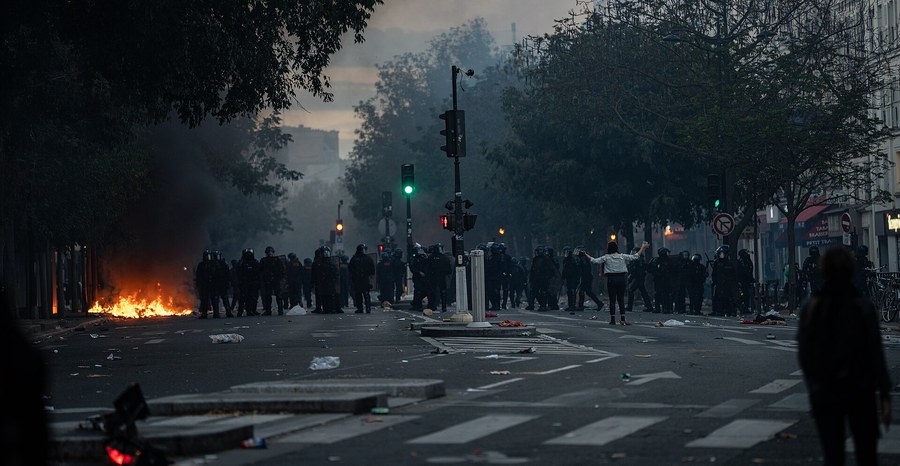
Soldiers from Operation Sentinelle, France's standing anti-terror patrol force, will guard fixed sites on Saturday, October 24, so police and gendarmes can be moved to crowd control. Prime Minister Sébastien Lecornu told the National Assembly the operation "will be massive" and admitted the October 17 deployment was "too static and not mobile enough." Violence and looting broke out on the fringes of the October 17 cost-of-living protests. President Emmanuel Macron blamed "ultra-left fringe groups," and Interior Minister Laurent Nuñez said "the very large majority of those arrested are adults; we are not dealing with the high-school students' movement."
Nuñez said elite police and gendarmerie units, helicopters, armored vehicles and water cannon will be used, and that prefects may ban undeclared marches likely to turn violent. France Télévisions reports a target of about 80,000 officers. Partial night curfews remain in Paris, Lyon and other cities, and France's 10-year borrowing cost passed 5% for the first time since 2002.
The high-school students' protests over teacher absences and crowded classes are a separate matter. Education Minister Édouard Geffray said representatives of schools, regions and students will be told Monday of "a first series of decisions" on class sizes, teacher replacement and university admissions. Unions met Lecornu and left without concrete measures.
Paris — France will deploy soldiers on its streets during the next nationwide day of protests, a step governments of the Fifth Republic have rarely taken. Interior Minister Laurent Nuñez told the National Assembly that troops from Operation Sentinelle, the army patrol created after the January 2015 terror attacks, will be "deployed in substitution for the internal security forces, mainly on static security missions, to free up police and gendarmes" for crowd control.
Prime Minister Sébastien Lecornu said "the return to order is the precondition for everything" and that Saturday's security operation "will be massive." He acknowledged that the deployment on October 17 had been "too static and not mobile enough." That day, nationwide marches billed as protests against the high cost of living, joined by high-school students, were followed by looting and arson on their fringes in several cities, which President Emmanuel Macron blamed on "ultra-left fringe groups."
What changes on Saturday
Nuñez said the government would bring in the national police units BRI and RAID, the gendarmerie's GIGN, helicopters, water cannon and Centaure armored vehicles, as it did during the riots of July 2023. He said the new approach is meant to be faster and more mobile in order "to go after these scattered groups that are extremely mobile." He also said prefects are considering banning undeclared marches likely to disturb public order, and even declared ones whose organizers cannot show they will keep them from getting out of hand.
France Télévisions reports that the goal is about 80,000 officers in total, close to the 89,000 deployed on December 8, 2018, during the yellow vest protests, and that police have been told to raise staff on duty from 60% on October 17 to 75% this weekend. Nuñez is due to give more details on Thursday, and President Emmanuel Macron will chair a security council meeting the same morning, the Élysée said.
Lecornu, as armed forces minister in March 2025, had said "you don't deploy the army against your own people." The Sentinelle soldiers are not trained in crowd control and will not be used for it.
Curfews and courts
Partial night curfews remain in force. In Paris, the police prefecture renewed for a third night a ban on anyone, adult or minor, entering the Place de la République and the area around Les Halles from 11 p.m. to 6 a.m., and barred undeclared gatherings near the Élysée Palace, parliament, the Champs-Élysées and the train stations. Lyon extended its curfew over its central Presqu'île district. Marseille, Bordeaux and Nice have curfews for minors only, mostly around shopping streets and malls that were looted. Lille and three nearby towns lifted theirs on October 21. Nearly 150 people have been jailed and more than 800 brought before the courts since the riots.
Borrowing costs
France's 10-year borrowing cost rose above 5% on October 21 for the first time since 2002, closing at 5.01%, and the gap over Germany's rate reached 1.59 percentage points, the widest since the euro debt crisis of 2011. The rise reflects persistent concern about France's public finances; public debt stands at a record 119% of GDP. The Economy Ministry said that "budget consolidation is the only way" and that "we will not deviate from it."
The fight over who is to blame
The debate in parliament turned on La France Insoumise, the left-wing party. Its leaders accuse Nuñez of steering intelligence services against the party, citing a report by the news site Mediapart; Nuñez denied it. "Intelligence services in this country do not work on political parties," he told the party's coordinator, Manuel Bompard, and added that the party had "thrown oil on the fire" and that its link with "certain small groups" was "real."
The students' demands
The high-school students, or lycéens, have protested for weeks over teacher absences, overcrowded classes and run-down schools. Speaking on the evening of October 17 about those arrested, Nuñez said: "The very large majority of those arrested are adults; we are not dealing with the high-school students' movement."
Education Minister Édouard Geffray told the National Assembly on October 21 that "from Monday morning, we will bring together all the representatives of the education community to present to them a first series of decisions" on class sizes, teacher replacement and Parcoursup, the national university admissions platform. Questions such as timetables and continuous assessment will be handled through government amendments to the 2027 budget bill. On the same day he said that of 114 high schools rated in critical condition for missing teachers, 21 remain. Earlier this month he sent 3,000 substitute teachers to schools that lacked them.
"Young people are a key priority," Lecornu told the Senate. "We have young people who need hope."
Student marches over school funding have also spread beyond France. Thousands of students and teachers marched in Athens on October 21, with protests in Thessaloniki and Patras, calling for more state investment in education; one banner read "From Greece to France, give money to education."
Unions set a strike date
Union leaders met Lecornu on October 21 for two and a half hours and came away without concrete measures, apart from a meeting within a month with the labor minister. Sophie Vénétitay of SNES-FSU, the largest secondary teachers' union, said the government's answers were "far below what one can expect." The CGT and the other unions called for a broad strike and mobilization on November 5.
Separately, EU prosecutors searched European Parliament offices of Patriots for Europe, the far-right group that includes Marine Le Pen's National Rally, in Brussels and Strasbourg on October 21, in an inquiry into about €4.3 million in EU funds allegedly misspent by its dissolved predecessor, Identity and Democracy, between 2019 and 2024. The group said it has no legal continuity with Identity and Democracy and is not involved in the investigation.
The first round of France's next presidential election is on April 18, 2027. Le Pen is the frontrunner.
- France 24 (AFP), Mobilisation du 24 octobre, what to know
- France 24, L'armée déployée le 24 octobre, des précédents rarissimes
- franceinfo, Sentinelle, GIGN, hélicoptères
- franceinfo, Geffray announces Monday meeting
- France Inter, Parcoursup and class-size measures Monday
- franceinfo, 3,000 substitute teachers
- 20 Minutes, curfews
- franceinfo (AFP), French 10-year rate passes 5%
- BBC News
- Fortune (AP), Athens protests
- France 24 (AFP), Patriots for Europe search
- CNews, October 17 live coverage (Nuñez quote)
- Le Parisien, Paris curfew renewed a third time
- Service Public, presidential election dates
- BFMTV, 21 of 114 high schools remain critical