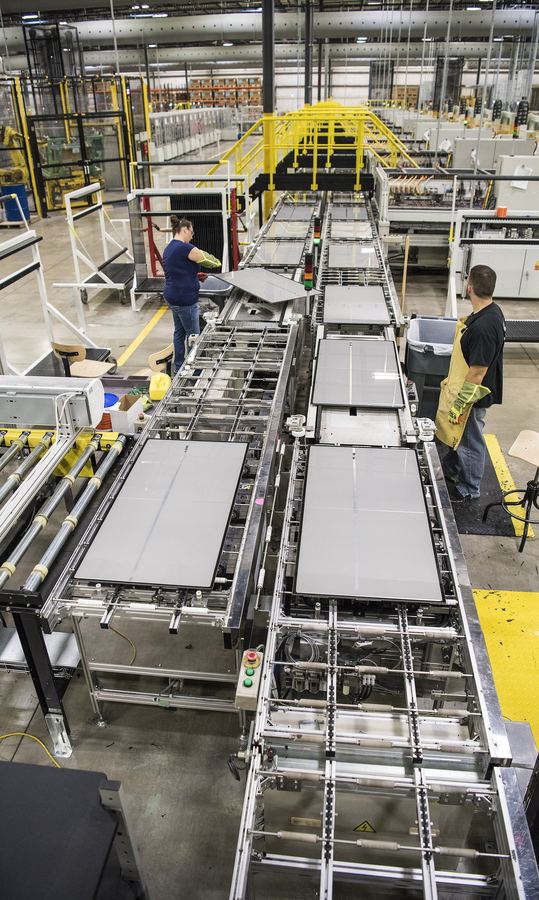
SEG Solar announced on 15 September 2026 — in a company release carried by pv magazine USA on 16 September — that the first heterojunction (HJT) module has rolled off the production line at its Tomball #1 manufacturing facility in the Greater Houston area. The company frames the milestone as the start of commercial-scale HJT module production at its second U.S. factory and as expanding its North American advanced-manufacturing footprint to an aggregate 6 GW of module production capacity. Soft FLAG: capacity totals and technology-performance claims in this piece are SEG’s as printed in that release; the desk did not open a separate factory tour or third-party audit.
The mechanism is cell-to-module process choice. Heterojunction modules, SEG says, deliver higher bifaciality, a lower temperature coefficient and lower degradation than conventional photovoltaic technologies — characteristics the company ties to higher lifetime energy production. Tomball #1 is described as designed for end-to-end digital management of manufacturing operations from order release and material flow to production execution, with AI-enabled inspection and advanced production scheduling integrated with automation equipment for quality, traceability and operational efficiency. Those tooling claims are company process descriptions, not independent yield data.
Expansion stack, attributed to the same release: SEG has already begun construction of an additional U.S. HJT module plant with 4.6 GW of annual capacity, expected to begin operations in 2027; once complete, total U.S. module manufacturing capacity would exceed 10.6 GW on the company’s arithmetic. SEG also says it is advancing a domestic solar campus with U.S. cell production targeted for 2028, aiming at vertical integration from ingots and wafers to cells and modules. Soft FLAG: 2027 and 2028 dates are company targets, not COD certificates.
Named actor: Jim Wood, CEO of SEG Solar, said the company had “doubled down on American manufacturing” amid “new policy challenges,” and that with Tomball #1 online and a “fully traceable” domestic supply chain the firm is accelerating toward a goal of becoming “America’s largest crystalline silicon module manufacturer.” Soft FLAG: that “largest” line is a CEO goal statement, not a present market-share finding — print as attributed intent.
Place context for the desk: Tomball sits in the Greater Houston manufacturing belt that has drawn multiple solar and power-electronics plants in recent cycles; SEG’s release does not publish a street address or employment headcount for Tomball #1 in the text opened here. Soft FLAG: no job-count figure appeared in the pv magazine USA press-release page opened for this pack — do not invent one. The “second U.S. factory” and “aggregate of 6GW” statements are the company’s own capacity arithmetic.
Policy colour stays attributed to Wood’s quote about “new policy challenges” — the release does not specify which statutes or tariff schedules he means, so the desk does not fill that gap. The load-bearing facts for this cut remain the first HJT module off the Tomball #1 line, the commercial-scale HJT claim, and the stated 6 GW aggregate with a 4.6 GW follow-on targeted for 2027.
What to watch without mood: first commercial shipment notices from Tomball #1; any public nameplate or interconnection filings that confirm the 6 GW aggregate figure; groundbreaking or equipment-set milestones at the 4.6 GW follow-on plant; 2028 cell-campus site selection or permit dockets.
Floor: Tomball #1 first HJT module off the line — SEG’s second U.S. factory; commercial-scale heterojunction; company puts U.S. module capacity at 6 GW aggregate.