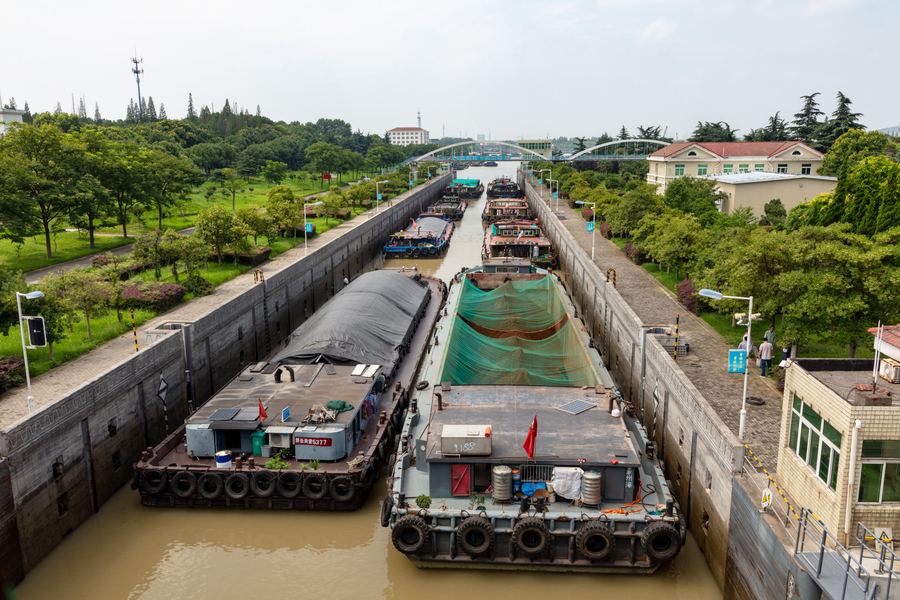
China opened the Pinglu Canal to navigation on Wednesday, 16 September 2026, according to Xinhua, China Daily, CGTN and Al Jazeera reports opened for this pack. The canal runs 134.2 kilometres in the Guangxi Zhuang Autonomous Region — China Daily puts the alignment from the Xijin reservoir at Hengzhou to Qinzhou Port on the Beibu Gulf; Xinhua’s lead frames the same route as linking Nanning’s port operations to the gulf. Built at a cost of 72.7 billion yuan (about 10.75–10.8 billion U.S. dollars in the outlets’ conversions), it is described by Xinhua and China Daily as the first river-to-sea canal planned and coordinated at the national level since the founding of the People’s Republic of China in 1949.
The mechanism is geographic and hydraulic. Until now, major inland rivers in Guangxi have tended to flow east, so waterborne cargo from Nanning and the Xijiang basin reached the sea via Guangdong ports, China Daily explains. Pinglu turns that cargo south to the Beibu Gulf — the closest maritime outlet for much of southwest China — and is designed for vessels of up to 5,000 tonnes. Xinhua says the canal shortens the inland waterway journey for goods from southwest China to the sea by more than 560 kilometres compared with traditional Guangdong routes, and that it is expected to cut overall logistics costs by 18 to 30 percent and save more than 5 billion yuan a year in transportation costs. Al Jazeera attributes the same distance and cost-range figures to Guangxi authorities, and cites Zhang Zhiwen, deputy secretary-general of the Guangxi government, for the more-than-5-billion-yuan annual transport-cost estimate.
Engineering detail, as Xinhua reports it: most of the canal was created by widening, deepening and straightening existing waterways, with a smaller section excavated through dry land and mountains. A roughly 65-metre difference in water level — Xinhua likens it to a building of more than twenty storeys — is handled by three navigation hubs, each with twin-line ship locks that raise and lower vessels. Environmental measures listed in the same Xinhua piece include reuse of more than 98 percent of about 315 million cubic metres of excavated earth and rock, a fish passage more than 480 metres long, and a dedicated wildlife crossing. Construction, China Daily says, started in August 2022.
Named actors and day-of traffic: China Daily reports Vice-Premier Ding Xuexiang attended the opening ceremony and called for using the waterway to develop a Beibu Gulf gateway port and support western opening-up. Lu Xinning, vice chairperson of the Guangxi regional government, is quoted by Xinhua on the canal as a new link between China’s market and ASEAN consumers. CGTN’s 16 September report says thirty cargo ships used the canal on opening day, and that new freight routes linking Nanning with Vietnam’s Can Tho and with Yangpu in Hainan began operating. Al Jazeera adds operational colour: commercial vessels pass the three water gates free of charge until 31 December 2026; from 1 January 2027 a trial fee of one yuan per tonne of vessel capacity applies through September 2031; river vessels can sail directly to Qinzhou seaport berths without transshipment. Soft FLAG: Global Times’ same-day “world records” framing (highest navigation capacity among similar canals, fastest lock transit, highest water head for water-saving locks, largest inland water-saving lock scale) is that outlet’s claim set — the desk attributes it and does not certify comparative rankings beyond the opened primary figures on length, cost, vessel class and distance saved.
Strategic frame, kept attributed: Xinhua and China Daily place Pinglu on the New International Land-Sea Trade Corridor linking inland China with ASEAN and other markets. Xinhua notes China–ASEAN trade exceeded 1 trillion U.S. dollars in the prior year and cites 744.41 billion dollars in the first seven months of 2026 (+24.7 percent year on year). Soft FLAG: Al Jazeera’s resettlement reporting (households relocated, housing models, resident quotes) is human-context colour from that outlet — not restated as desk verification of every figure.
What to watch without mood: whether the Nanning–Can Tho and Nanning–Yangpu sailings settle into a published schedule; any Guangxi or Beibu Gulf Port Authority traffic tallies after the free-transit window; fee implementation on 1 January 2027; Phase progress on Qinzhou gateway-port upgrades Ding Xuexiang flagged.
Floor: Pinglu Canal open 16 Sep — 134.2 km river-to-sea to Beibu Gulf; 5,000-tonne class; >560 km shorter inland run; three twin-line lock hubs.