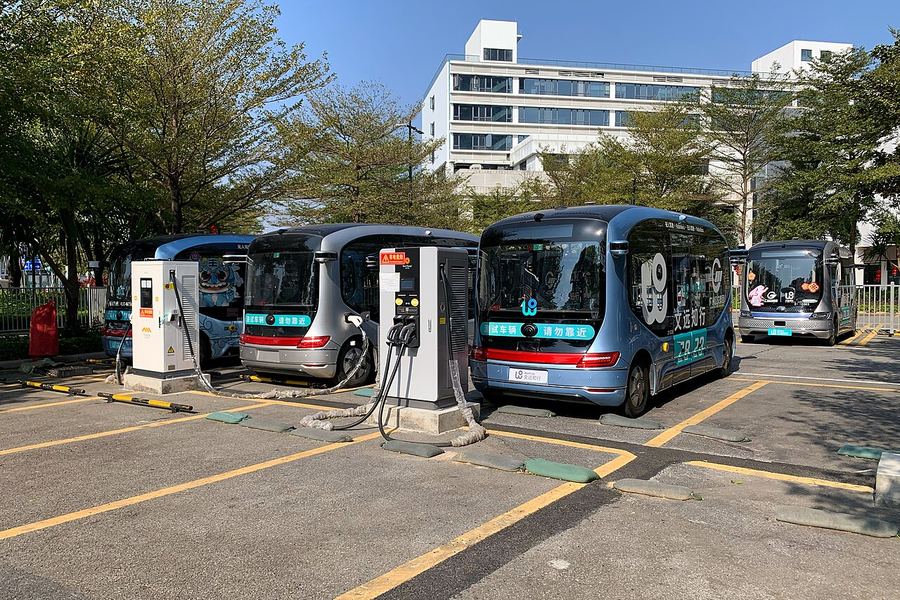
Zurich Airport’s newsroom said on 9 September that two shuttle buses are now operating fully automated on airport premises with no safety driver on board, monitored from a remote cockpit, and that the first fully automated trips took place at the beginning of September. The airport frames itself as “one of the first airports in Europe” to take that step — claim language the desk attributes to Flughafen Zürich AG, not an independent ranking. Tech Times’s 14 September feature goes further and calls the deployment “Europe’s first” driverless L4 bus with no driver and no monitor on board; that superlative stays attributed to the outlet.
The mechanism is SAE Level 4 inside a bounded operational design domain. Since March 2025, Zurich Airport Ltd. has worked with Chinese autonomy company WeRide on automated driving on the airport grounds. The airport says extensive regulations, safety requirements, and technical conditions required a phased approach. The step now taken — operation without a safety driver on board and with monitoring from a remote cockpit — corresponds to the targeted automation level, Level 4, without a safety driver in the vehicle. Tech Times notes the vehicles handle driving without any human in the seat while remote workers elsewhere on the airport grounds can intervene if needed.
The vehicles deployed in the pilot serve as an employee shuttle and operate on a defined route. Aircraft taxiways are not crossed. The buses complete the journey independently. Employees of partner companies Swissport and Krummen Kerzers monitor from the remote cockpit and can intervene to provide support if needed. The former onboard safety drivers have been trained for the remote role and will accompany operations remotely going forward, the airport says. Tech Times adds that under SAE definitions updated to incorporate remote driving provisions, remote cockpit operators are not treated as “drivers” in the L4 sense during normal operation — the automated system remains responsible inside its ODD — a standards note attributed to that feature, not a legal opinion from this desk.
Over the past year and a half, the two buses covered more than 15,000 kilometres (Tech Times converts that to about 9,321 miles). Safety processes were developed and technical and operational procedures thoroughly tested. At the start of each new project stage, a passenger-free test phase ran before employees were permitted to use the shuttle. The same rule governs the Level 4 cutover. Senior Innovation Manager Raphaël Glaesener: “Safety was and remains our top priority at all times. That is why the first Level 4 trips will once again be carried out without passengers. However, we expect that after around four weeks of test operation, employees will be able to use the now fully automated shuttle.”
Coralie Klaus Boecker, Head of the ZRH Innovation Hub at Zurich Airport Ltd., said the airport is pleased with the achievement and that gradual automation of vehicles can make an important contribution given emerging skilled-worker shortages, laying groundwork for safe automated deployment for the airport and its partners. Glaesener separately restated the labour model: “Automated driving does not mean that people disappear. But the tasks change. Operations will also become more efficient, because in the future one employee will be able to monitor several buses.”
Tech Times supplies secondary hardware colour the desk keeps brief and attributed: WeRide Robobus units co-developed with Renault; a sensor suite described as combining multi-channel LiDAR, cameras of varying fields of view, and 77 GHz millimeter-wave radar as a fallback modality in the airport’s dense RF environment. The operational milestone on this page remains the airport’s own: empty L4 runs now, employee boarding expected after about four weeks, pilot planned through the end of 2026. A potential continuation with the two current vehicles is under review with project partners; regardless, Flughafen Zürich AG says findings will inform future use of further automated vehicles across the estate.
What comes next without mood: the roughly four-week mark for employee boarding on the now fully automated shuttle; the year-end pilot decision; any public notice expanding beyond two buses or the current non-taxiway apron route.
Floor: Early Sep 2026 — L4 apron shuttles, no onboard driver/monitor; remote cockpit live; employee rides expected after ~4 weeks of empty L4 runs; pilot through end-2026.