MOL’s 10 September release says the naming ceremony was held at Hanwha Ocean Co., Ltd.’s Geoje Shipyard in South Korea. Molly T. Laegeler, president of Chevron’s Supply & Trading business, named the ship as godmother. The vessel will be delivered under a long-term charter contract to Chevron Corporation at the end of September 2026. MOL describes the Wind Challenger as a hard-sail wind-assisted propulsion system expected to reduce fuel consumption and associated greenhouse-gas emissions compared with conventional propulsion alone.
Main specifications on the company page are concrete enough to file without padding: length overall 294.9 metres, breadth 46.4 metres, 174,000 cubic metres of membrane-type tanks, an ME-GA dual-fuel main engine (Everllence / formerly MAN Energy Solutions low-pressure LNG dual-fuel), an air-lubrication system that generates microbubbles under the hull to cut friction, and a shaft generator that makes electricity from main-engine shaft power so auxiliary generators run less. Two Wind Challenger units are fitted. Maritime Executive, publishing the same day from the MOL materials, puts each telescoping rigid sail at about 49 metres (160 feet) above the deck when fully extended and about 15 metres (49 feet) wide, three fiber-reinforced plastic panels per sail, mounted near the bow. Ship management will sit with MOL Global Ship Management Pte. Ltd., a wholly owned MOL subsidiary.
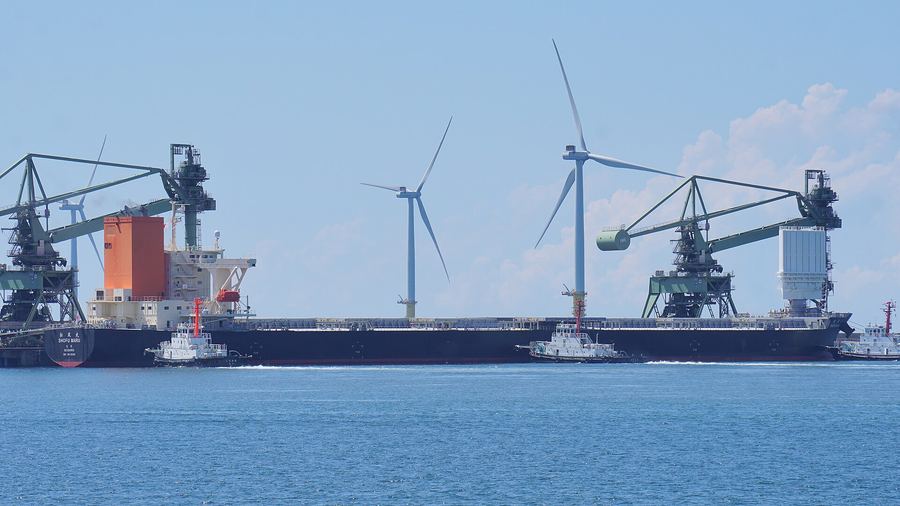
MOL’s world-first claims are stated plainly on the release: first LNG carrier equipped with a wind-assisted propulsion system, and first vessel of any type equipped with two Wind Challenger units. It is the fourth MOL Group ship to carry the system — after coal carriers Shofu Maru and Kurotakisan Maru III and bulk carrier GREEN WINDS — and sits among eleven Wind Challenger ships the group lists as delivered or scheduled. A second similarly sized LNG carrier with two sails is due later this year under charter to Tokyo LNG Tanker Co., a Tokyo Gas subsidiary, also building at Hanwha Ocean’s Geoje yard. Six further bulk carriers on order at Oshima Shipbuilding will each take one sail. MOL’s environmental plan targets 25 Wind Challenger ships by 2030 and 80 by 2035.
Getting sails onto a membrane LNG carrier is not a bolt-on aesthetic. Maritime Executive notes that MOL, Chevron, and Hanwha worked to place the units so the existing mooring arrangement and shore compatibility stay intact, limiting windage impact. ClassNK granted Approval in Principle in 2024 after a risk assessment covering sail placement, visibility, emergency procedures, and other safety measures. GTT, which holds membrane-tank patents, evaluated cargo-tank effects from the sail installation. First public images of the outfitted hull appeared in May during yard work after the sails went on. Laegeler’s naming remarks, printed by MOL, put the milestone in supply-chain language: trusted partnerships, continuous innovation, and lower carbon intensity for LNG transportation while keeping delivery reliable.
What the desk can observe without inventing a savings percentage for this hull: the hardware is installed; the name is affixed; the charterer is Chevron; the delivery date on the company release is end of September. Prior Wind Challenger coal-carrier fuel-savings figures belong to a different ship class and are not used here as a proxy for FUJIN SAILOR’s first laden miles.
Floor: Named 10 Sep at Geoje; Chevron long-term charter; delivery framed for end of September 2026.